
AI
OpenAI’s Codex Micro Is a Macro Pad, Not a Pocket Device
OpenAI’s Codex Micro launches July 15 as a Work Louder-built macro pad for Codex’s 5 million weekly users, running in parallel to the delayed Jony Ive device.

OpenAI’s Codex Micro is a macro pad, not a pocket device, and that mismatch with months of speculation about a Jony Ive-built AI gadget is the point. On June 29 the OpenAI Developers account posted a short teaser video showing a square device with several buttons and the caption “Your favorite Codex shortcuts are getting an upgrade,” with a date stamp for July 15th. The hardware partner is Work Louder, a Montréal mechanical-keyboard maker whose existing macro pads ship with mappable keys, dials, and switches, which is what the teaser silhouette matches.
Unlike the Ive-OpenAI project, which has been the subject of public anticipation for most of the year, this announcement came as a co-branded accessory for an existing piece of software. The Verge reported the collaboration based on the teaser and the company’s previous partnerships. OpenAI’s announcement landed on the same day a developer tool that already counts millions of weekly users added role-specific plugins aimed at analysts, marketers, and lawyers, a quiet reminder of where most of the company’s active compute hours are actually going.
A Hardware Launch Built Around One Shortcut
OpenAI teased the device on X with a 38-second clip of a square macro pad bathed in RGB underglow, captioned “Your favorite Codex shortcuts are getting an upgrade.” Alongside it, the company set July 15 as the date for the full reveal, two weeks ahead of the post. The Verge reported it on June 29, after spotting the silhouette’s resemblance to a product Work Louder already sells, and noted that neither company shared any more product detail beyond the launch date.
The spokesperson named in event coverage was Dominik Kundel, OpenAI’s developer relations lead. According to a KuCoin republication of WeChat outlet APPSO’s reporting from the unveil, Kundel said the keyboard “will significantly enhance people’s efficiency when using Codex,” framed as a developer productivity tool rather than a stand-alone consumer gadget. The event description, naming the show as the “Artificial Intelligence Engineers World Expo,” comes from the same third-party recap and has not been independently confirmed in coverage I could verify, so the show name is reported here as the venue that recap cited rather than as established fact.
If the rest of the picture holds, July 15 brings a Work Louder-built Codex-skinned input device aimed at the people who already spend their days inside OpenAI’s coding tool, not a screenless companion, not a phone, not the Ive device sitting on the public roadmap for next year. The Verge’s the July 15 tease of Codex Micro is the most direct source for the announcement language.
The Creator Micro 2 Foundation
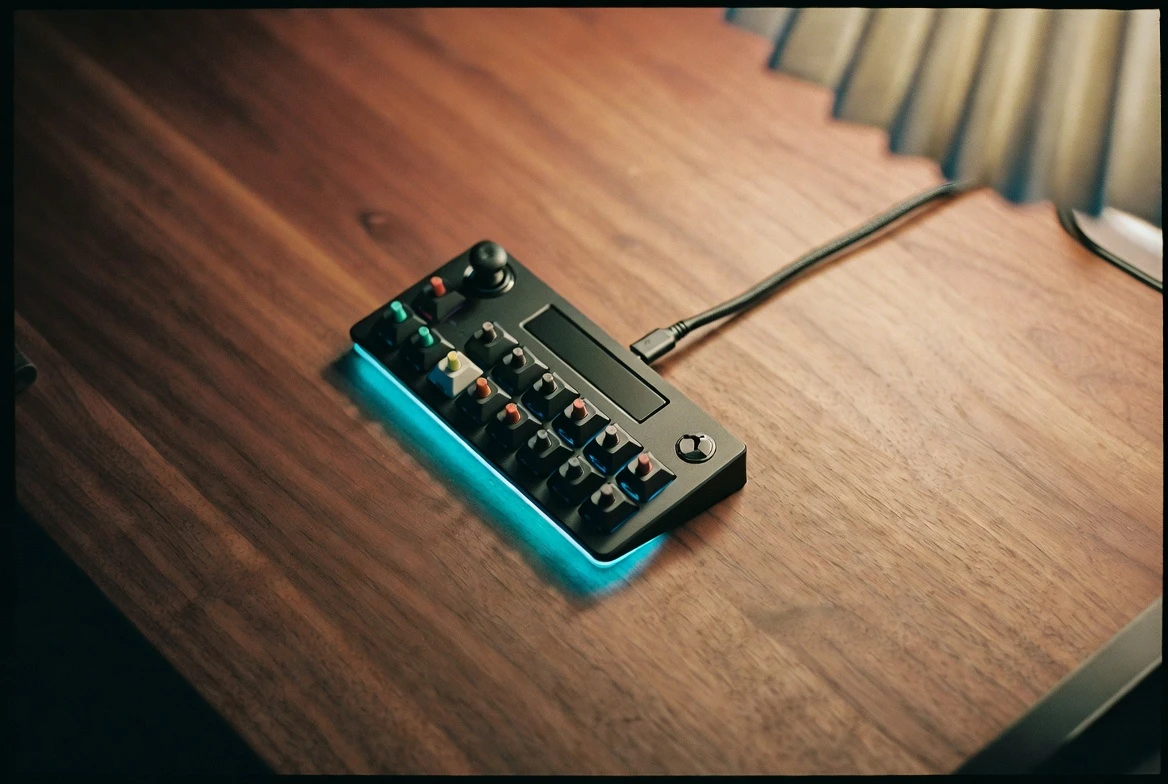
The teaser in the OpenAI Developers clip looks like Work Louder’s Creator Micro 2, a small macro pad with 13 mechanical switches, a joystick, a touch sensor, and a rotary encoder. The Verge flagged the resemblance, and Work Louder’s own product page lists every one of those parts, along with RGB backlight and underglow, USB-C connectivity, and Bluetooth on the higher-tier Pro model. The base Creator Micro 2 starts at $144 for the wired model; the Pro, with a Bluetooth radio and a 2100mAh battery, starts at $174.
Work Louder has shipped similar co-branded pads before. In 2023, Figma partnered with the company on the Figma Creator Micro, a 12-key macro pad preloaded with shortcuts for Figma’s design tool. Figma’s own product blog described the partnership as part of what the company calls “the handoff,” a series of collaborations with modular keyboard makers. The pattern of “productivity tool as physical accessory” is what Codex Micro would extend to developers if, as expected, it ships in the same Creator Micro 2 form factor.
What stays open is what the Codex-specific version actually changes. The teaser does not show new hardware, so the most likely move is software: a preset layer that maps the 13 keys, the joystick, the encoder, and the touch sensor to Codex actions. Work Louder’s Creator Micro 2 specs set the bounds for what those keys could be mapped to.
| Specification | Creator Micro 2 (Base) | Creator Micro 2 (Pro) | Codex Micro (as teased) |
|---|---|---|---|
| Mechanical switches | 13 | 13 | Not stated; silhouette matches |
| Joystick | Yes | Yes | Not stated; silhouette matches |
| Touch sensor | 1 | 1 | Not stated; silhouette matches |
| Rotary encoder | 1 | 1 | Not stated |
| Connectivity | USB-C wired | USB-C + Bluetooth, 2100mAh battery | Not stated |
| RGB underglow | Yes | Yes | Yes (visible in teaser) |
| Starting price | $144 | $174 | Not disclosed |
Five Million Weekly Codex Users Sit Behind It
The reason a small Work Louder pad matters at all is that Codex has become a daily tool, not a developer curiosity. OpenAI’s own announcement page, dated in the same news cycle, opens with the line: “More than 5 million people now use Codex every week.” That is 5 million weekly active users, up more than 6x since the desktop app launched in February 2026, and a number that puts Codex in the same conversation as other consumer-grade OpenAI products even though it began as a developer-only tool.
The user base has also broadened. Non-developers now account for about 20% of overall Codex users and are growing more than 3x as fast as developers, according to the same OpenAI announcement. The company is shipping new role-specific plugins covering data analytics, creative production, sales, product design, public equity investing, and investment banking, each bundling connector apps and pre-built skills. The shift lines up with the brief’s core claim: the macro pad is for the size of the user base that already exists, not a bet on creating one.
Inside OpenAI itself, adoption is near-total. In a recent appearance on Lenny’s Newsletter, Andrew Ambrosino, the product and engineering lead for the Codex desktop app at OpenAI, said nearly 100% of OpenAI employees use Codex weekly, not only engineers. Teams in marketing, legal, finance, and communications build internal apps, prep executive materials, manage releases, read Slack, and pull analysis through Codex the same way engineers use it for code. For a usage pattern this density, a dedicated shortcut surface is a small gesture that compounds.
Snapshot: Codex at launch
- 5 million+ weekly active Codex users (OpenAI, June 2026)
- 6x growth since the desktop app launched in February 2026
- ~20% of Codex users are non-developers, and that group is growing more than 3x faster than developers
- ~100% of OpenAI’s own employees use Codex weekly (Lenny’s Newsletter interview with Andrew Ambrosino)
OpenAI’s Two Hardware Tracks Running Side by Side
OpenAI’s consumer hardware plans have been the bigger story all year. OpenAI announced the acquisition of Jony Ive’s hardware firm LoveFrom’s predecessor, io Products, in a deal valued at nearly $6.5 billion. The signature product, a screenless AI device, has been variously described in public reporting as a possible earpiece, pen, or other wearable.
That timeline has slipped. According to a sworn statement from Peter Welinder, OpenAI’s vice president and general manager, included in a court filing in the dispute with startup Iyo over the “io” trademark, the company “expects its first hardware device will not ship to customers before the end of end of February 2027.” The Verge reported the broader dispute over the trademark and the rollout, and Business Insider reported the timeline.
Two different bets are now visibly running in parallel: a productivity accessory for a tool millions of people already use, and a flagship AI-native device for a future market. OpenAI’s consumer hardware division is also drawing talent directly from Apple hardware engineering, with senior hires reported across the past year. the February 2027 shipping update in OpenAI’s court filing is the cleanest public reference for the delayed flagship timeline. Related reading includes where Codex and Claude Code each lead in 2026 for the coding-agent competitive context, and OpenAI’s hardware hiring from Apple for the parallel talent build.
- Source of the device: Work Louder, a Montréal mechanical-keyboard maker with a strong following among productivity enthusiasts vs LoveFrom, Jony Ive’s design firm, whose predecessor io Products was acquired by OpenAI in a deal valued at nearly $6.5 billion.
- Shipping timeline: Work Louder-built Codex Micro launches July 15, 2026 vs the Ive-OpenAI flagship device, which per OpenAI’s court filing will not ship before end of February 2027.
- Target audience: developers and the 5 million weekly Codex users vs a new screenless AI-native device for general consumers, with form factor still publicly undecided.
The Counter-Bet to the AI Gadget Wave
The last three years of consumer AI hardware have produced a graveyard of voice-first devices that tried to replace the phone and fell short. The Humane AI Pin raised about $230 million and reportedly shipped fewer than 10,000 units before selling to HP for roughly $116 million; the Rabbit R1 sold more than 100,000 units and then absorbed mass returns once reviewers got hold of it. Jony Ive, in remarks carried by The Verge around the io merger, called the category “poor products,” framing the failures as a design failure rather than a software one.
poor products
The remark from Jony Ive, the designer of the iMac and iPhone, was directed at the previous AI gadget efforts as his team prepared for what he and Sam Altman have described as a different kind of device: something built on years of hardware thinking, not a microwavable shortcut to a smartphone replacement.
Codex Micro pushes against that wave on purpose. The form factor is what people already use to be productive, a keyboard with extra inputs, not a screenless, voice-first object. The tethered device targets a known user base, the daily user of a tool OpenAI already runs, rather than a future audience that has not yet decided to leave the phone in the drawer. OpenAI’s own tone in this launch is closer to Figma in 2023 than to Humane in 2024: brand it, ship a preset layer, let the keyboard community do the rest.
What Is Still Unclear at Launch
OpenAI has not disclosed the price of the Codex Micro, and whether the shortcut layer ships as a static Codex preset, a partially editable map, or a fully programmable SDK. Work Louder’s Creator Micro 2 sits at $144 wired and $174 with Bluetooth; a Codex-skinned version could land anywhere in that range, significantly above it for a tooled-up collaboration, or below it if OpenAI is subsidizing the device for ecosystem pull, but neither company has said.
What we know on July 1: a macro pad co-branded by OpenAI and Work Louder is a real, dated product coming July 15. What we do not know is what the keys do, how programmable they are, who the first customers will be beyond developer-influencer circles, and whether this is one device or the first of a peripheral line tied to Codex and future OpenAI software. Everything else about the device, including pricing, lives two weeks downstream.
Frequently Asked Questions
What is the OpenAI Codex Micro?
Codex Micro is a macro pad that OpenAI is releasing on July 15, 2026, in collaboration with Work Louder. The silhouette shown in the June 29 teaser resembles Work Louder’s Creator Micro 2, a 13-key macro pad with a joystick, a touch sensor, and a rotary encoder, and the device is positioned as a shortcut surface for Codex, OpenAI’s AI coding agent.
How much will it cost?
Neither OpenAI nor Work Louder has disclosed a price for the Codex Micro. For context, Work Louder’s existing Creator Micro 2 starts at $144 for the wired base version and $174 for the Bluetooth-equipped Pro model, but those are the prices of the company’s own product, not the Codex-branded version.
How is Codex Micro different from OpenAI’s Jony Ive device?
Codex Micro is a Work Louder-built macro pad for Codex, launching July 15, 2026. OpenAI’s flagship consumer device, designed with Jony Ive’s LoveFrom, is a separate project and, according to an OpenAI court filing in the dispute with Iyo, will not ship to customers before the end of February 2027.
Who is Codex Micro for?
The device is aimed at the more than 5 million people who use Codex every week, a base that OpenAI says has grown more than 6x since the Codex desktop app launched in February 2026 and that now includes analysts, marketers, designers, and other non-developers alongside engineers. Inside OpenAI, adoption is near-total.


South Korea Retail Investors Face Reckoning After KOSPI AI Rally Collapses

Surrey AI Maps Three Heart Attack Paths and Their Molecular Roots

Germany Locks Neutral Apple ATT Prompts Across Most of Europe

Apple’s 5% EU Fee Quietly Rewrites Alternative App Store Math

Apple’s EU Fee Truce Cuts Complexity but Leaves Rivals Fuming

Pixel 11 Pro Fold Trades Thinness for Durability and Seven-Year Stay

Mayo AI Flags HCM Obstruction From Everyday Ultrasound Videos

Indian Brands Quietly Scale Landmark Screens and Home Tech

Navin Vatsa Turns Grief Into a Lifetime of Quiet Seeing

Google Bets Pixel 11 Agentic AI Will Redefine Phones

Oracle Cuts 21,000 Jobs in a Year, Cites AI in 10-K Filing

Fable 5 and Mythos 5 Return as US Lifts Anthropic Export Controls

SpaceX’s Google Deal Turns a Rocket Company Into a Cloud Landlord

CD Projekt Red Co-CEO: Redemption Arc Isn’t Done, Witcher 4 in 2027

XPL Rallies 30% Ahead of Plasma One Card Tier Launch

Google Search Profiles Build a Follow Graph Inside Discover

DGO App Brings Rs 549 Mobile Pass for FIFA World Cup 2026 in Nepal

Moonshot AI Targets $30 Billion in China’s Fastest AI Funding Sprint

Oppo’s ColorOS 17 Eligibility List Leaves A-Series Buyers Behind

Microsoft Xbox Layoffs Start in July as Sharma Slams 3% Margin
-
 AI2 months ago
Oracle Cuts 21,000 Jobs in a Year, Cites AI in 10-K Filing
-
 AI2 months ago
Fable 5 and Mythos 5 Return as US Lifts Anthropic Export Controls
-
 AI2 months ago
SpaceX’s Google Deal Turns a Rocket Company Into a Cloud Landlord
-
 GAMING2 months ago
CD Projekt Red Co-CEO: Redemption Arc Isn’t Done, Witcher 4 in 2027
-
 CRYPTO2 months ago
XPL Rallies 30% Ahead of Plasma One Card Tier Launch
-
 NEWS2 months ago
Google Search Profiles Build a Follow Graph Inside Discover
-
 APPS2 months ago
DGO App Brings Rs 549 Mobile Pass for FIFA World Cup 2026 in Nepal
-
 AI2 months ago
Moonshot AI Targets $30 Billion in China’s Fastest AI Funding Sprint