
AI
Apple’s $650 Billion Rally Comes With a Richer Price Tag
Apple’s stock surged 16% and added $650 billion in value as investors fled AI spending fears, but the rally has made shares pricier than ever.

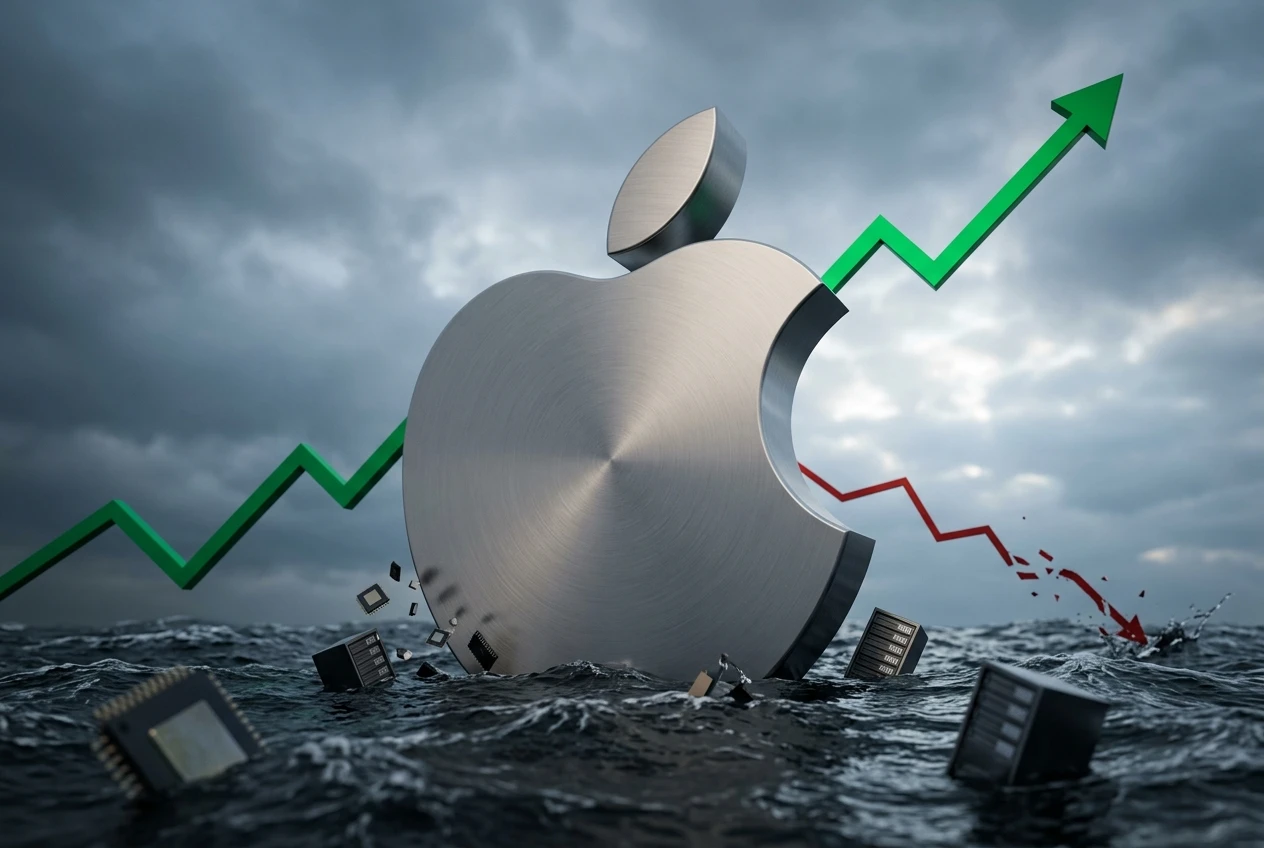
Apple’s stock closed at a fresh record again this week, with shares trading above $322 and the company’s market value approaching $4.7 trillion. The move caps a 16% surge since June 25 that has added roughly $650 billion in market value, according to Bloomberg, making Apple the best-performing stock among the so-called Magnificent Seven so far this year.
The money did not appear from nowhere. It is flowing out of chipmakers and cloud giants pouring billions into artificial intelligence data centers and into a company that mostly sat out that spending spree. The trade has run so hard in one direction that Apple is now more expensive, relative to its own history, than it was before anyone worried about an AI bubble.
Apple’s Gains Dwarf the Semiconductor Slide
Apple shares gained 1.4% on Monday alone to reach a new all-time high, then pushed further past $322 on Tuesday. The climb stands apart from the rest of the chip trade. The Philadelphia Semiconductor Index has fallen about 10% over the same stretch, even though it remains up roughly 78% for the year and on pace for its best performance since 1999.
| Benchmark | Move Since June 25 | 2026 Context |
|---|---|---|
| Apple (AAPL) | +16%, about $650 billion added | Fresh record high; best Magnificent Seven performer this year |
| Philadelphia Semiconductor Index | -10% | Still up roughly 78% in 2026, on pace for its best year since 1999 |
| S&P 500 | +3% | Broad benchmark kept climbing through the rotation |
| Nasdaq 100 | +0.3% | Barely moved as chip and cloud names wobbled |
The climb has also reordered the pecking order among the Magnificent Seven. Microsoft is down about 20% in 2026, on pace for its worst year since 2022, while Alphabet and Amazon are both more than 10% below their May highs. Nvidia, Meta and Tesla have all trailed Apple’s gain this year too.
Why Wall Street Is Rewarding AI Restraint
The shift traces to one worry gripping the market: that the hundreds of billions of dollars committed to AI data centers might not pay off. Unlike Microsoft, Alphabet, Amazon and Meta, Apple has largely avoided that arms race. Instead, it pays Google for access to its Gemini models to underpin a revamped Siri, Bloomberg reported.
“There’s a battle in the market, and right now Apple is benefiting because it isn’t in the storm that the rest of the AI trade is in,”
said Mark Bronzo, chief investment strategist at Rye Strategic Partners, an investment firm. Bronzo said investors are worried about what kind of return hyperscalers will get on their AI spending, and that semiconductor valuations have run ahead of themselves, pushing money back toward what he called a steady name without those risks.
Apple has still spent to protect its own supply chain. It committed more than $30 billion to Broadcom for custom silicon and wireless connectivity components in a deal that runs through 2031 and is expected to support production of 15 billion US made chips, alongside a $1.5 billion expansion of Broadcom’s Fort Collins, Colorado facility.
Apple is also defending the AI work it already has. On July 10, the company sued OpenAI and two former employees, accusing them of stealing trade secrets tied to hardware projects. The timing is notable only in that it shows Apple fighting on two fronts at once: leaning on a rival’s AI models in public while suing that same rival’s orbit in court.
The Price Hike That Marked the Bottom
The rally’s starting point traces back to a rough few weeks that began at Apple’s own developer conference. The WWDC keynote’s AI showcase landed with a thud, and then a pricing decision made things worse before they got better.
- Early June 2026: Apple’s WWDC keynote unveils iOS 27 and macOS Golden Gate AI features to a muted reception, and shares slide.
- June 25, 2026: Apple raises prices on Macs, iPads and home devices to offset rising memory chip costs, leaving iPhone pricing untouched. The stock suffers its worst single-day drop since April 2025, marking the low of the rally.
- July 13, 2026: Shares climb 1.4% to a fresh all-time high.
- July 14, 2026: Shares trade above $322, with market capitalization approaching $4.7 trillion.
Apple has hinted that further price increases are possible if memory costs keep climbing, though iPhone pricing has been spared so far. Supply chain sources described the September launch timeline as on track despite earlier chatter about hinge-related delays. JPMorgan analyst Samik Chatterjee raised his price target to $345 after the move, writing in a July 7 note that “long-term trends suggest that pricing has limited implications on volume opportunity over a multi-year period.” Citi has gone further, lifting its own target to $365 from $315 and reaffirming a buy rating.
Is Apple’s Rally Getting Ahead of Its Fundamentals?
Apple trades at about 34 times projected earnings, well above its 10-year average of 23 times, and only 61% of analysts tracked by Bloomberg rate the stock a buy, versus 90% for Microsoft, Amazon, Meta and Nvidia. Insiders have sold $87.6 million in shares over three months, and at least one research firm has bet the stock falls.
- 34 times forward earnings – Apple’s current multiple, against a 10-year average of 23 times.
- 61% buy ratings – the share of analysts covering Apple who recommend buying it, compared with 90% for Microsoft, Amazon, Meta and Nvidia.
- $87.6 million – insider stock sales over the past three months.
- 23% downside – the decline targeted by Hedgeye’s short call on the stock.
Hedgeye analyst Felix Wang argued that Apple’s history of beating revenue expectations may be fading, pointing to services growth assumptions and iPhone demand forecasts that look optimistic against rising competition from Huawei. Separate valuation models built around discounted cash flow have reached similar conclusions, putting Apple’s intrinsic value meaningfully below where the stock trades today. None of that has slowed the buying so far.
The Foldable iPhone Wager
Apple’s next real test of demand arrives with its first foldable iPhone, expected alongside the iPhone 18 Pro lineup in September. Supply chain reports cited by Nikkei Asia say Apple has raised its production target to 10 million units this year, up from a prior plan of seven to eight million, as part of a lineup of at least five new iPhone models stretching into early 2027.
Ming-Chi Kuo, a TF International Securities analyst who closely tracks Apple’s supply chain, said the device could sell out immediately after preorders open, with delivery times potentially stretching for weeks afterward. Pricing is expected to land between $2,300 and $2,500.
- Execution risk – Apple has never shipped a foldable device, and hinges, unique displays and manufacturing yields are all difficult to get right on a first try.
- Demand risk – Kuo says the real test of true demand will not arrive until late 2026 through early 2027, after launch hype fades and supply catches up.
- Trading risk – Jefferies has cautioned the stock could stay range-bound in the near term given uncertainty about broader product demand ahead of the launch window.
The device also fits a pattern investors have started to reward: Apple pushing AI into devices rather than into server farms. The company’s dominant share of AI smartwatch shipments shows the same playbook already working in wearables, years before this rotation trade existed.
Apple Faces Its First Real Test on July 30
Apple reports fiscal third-quarter results on July 30, having guided for revenue growth of 14% to 17%. In the quarter ended March 28, iPhone revenue rose 22% year over year to about $57 billion, a March-quarter record, within $111 billion in total revenue and diluted earnings of $2.01 a share.
Apple is projected to generate a record $140 billion in free cash flow this fiscal year, more than 40% above last year’s total. One estimate puts Alphabet’s free cash flow falling roughly 67% to $21 billion this year as it funds its own AI buildout, a contrast that captures why investors have swapped one stock for the other.
The rally also arrives with a leadership change built in. Tim Cook is stepping down as chief executive on September 1, handing the role to John Ternus, Apple’s senior vice president of hardware engineering, right as the foldable phone and the earnings report both land on the new chief’s desk. Apple reports earnings on July 30, with a new chief executive already waiting in the wings.
Frequently Asked Questions
Why Is Apple Stock Rising While AI Stocks Fall?
Investors are rotating out of chipmakers and cloud companies facing questions about AI spending returns and into Apple, which avoided the data center buildout. Taiwan Semiconductor still reported a 36% jump in quarterly sales, and South Korea’s SK Hynix tumbled a record 15% in a single day, showing the anxiety is about payoff timing, not whether AI demand itself is slowing.
How Much Has Apple’s Market Value Increased Since June?
Apple has added about $650 billion in market value since bottoming on June 25, a 16% gain that pushed shares from a Friday close of $315.32 past the prior record of $317.40 set in early June and on to new highs since.
What Is Apple’s Market Capitalization Right Now?
Apple’s market capitalization is approaching $4.7 trillion as of this week, with share prices above $322, keeping it among the two most valuable publicly traded companies in the world.
When Does Apple Report Earnings Next?
Apple reports fiscal third-quarter 2026 results on July 30. Management’s 14% to 17% revenue growth guidance was set before this rally began, making the report the first hard data point Wall Street gets since the rotation into Apple started.
When Will Apple’s Foldable iPhone Launch?
Apple’s foldable iPhone is expected in September alongside the iPhone 18 Pro lineup. Initial shipments are projected at just 500,000 to 1 million units in the third quarter, a fraction of the 10 million Apple is targeting for the full year.
Disclaimer: This article is for informational purposes only and does not constitute investment advice. Stock prices, valuations and analyst forecasts carry risk and can change quickly; consult a licensed financial professional before making investment decisions. Figures are accurate as of publication on July 14, 2026.


South Korea Retail Investors Face Reckoning After KOSPI AI Rally Collapses

Surrey AI Maps Three Heart Attack Paths and Their Molecular Roots

Germany Locks Neutral Apple ATT Prompts Across Most of Europe

Apple’s 5% EU Fee Quietly Rewrites Alternative App Store Math

Apple’s EU Fee Truce Cuts Complexity but Leaves Rivals Fuming

Pixel 11 Pro Fold Trades Thinness for Durability and Seven-Year Stay

Mayo AI Flags HCM Obstruction From Everyday Ultrasound Videos

Indian Brands Quietly Scale Landmark Screens and Home Tech

Navin Vatsa Turns Grief Into a Lifetime of Quiet Seeing

Google Bets Pixel 11 Agentic AI Will Redefine Phones

Oracle Cuts 21,000 Jobs in a Year, Cites AI in 10-K Filing

Fable 5 and Mythos 5 Return as US Lifts Anthropic Export Controls

SpaceX’s Google Deal Turns a Rocket Company Into a Cloud Landlord

CD Projekt Red Co-CEO: Redemption Arc Isn’t Done, Witcher 4 in 2027

XPL Rallies 30% Ahead of Plasma One Card Tier Launch

Google Search Profiles Build a Follow Graph Inside Discover

DGO App Brings Rs 549 Mobile Pass for FIFA World Cup 2026 in Nepal

Moonshot AI Targets $30 Billion in China’s Fastest AI Funding Sprint

Oppo’s ColorOS 17 Eligibility List Leaves A-Series Buyers Behind

Microsoft Xbox Layoffs Start in July as Sharma Slams 3% Margin
-
 AI2 months ago
Oracle Cuts 21,000 Jobs in a Year, Cites AI in 10-K Filing
-
 AI2 months ago
Fable 5 and Mythos 5 Return as US Lifts Anthropic Export Controls
-
 AI3 months ago
SpaceX’s Google Deal Turns a Rocket Company Into a Cloud Landlord
-
 GAMING2 months ago
CD Projekt Red Co-CEO: Redemption Arc Isn’t Done, Witcher 4 in 2027
-
 CRYPTO3 months ago
XPL Rallies 30% Ahead of Plasma One Card Tier Launch
-
 NEWS3 months ago
Google Search Profiles Build a Follow Graph Inside Discover
-
 APPS3 months ago
DGO App Brings Rs 549 Mobile Pass for FIFA World Cup 2026 in Nepal
-
 AI3 months ago
Moonshot AI Targets $30 Billion in China’s Fastest AI Funding Sprint