
NEWS
ECT’s REM Pilot System Targets In-Situ PFAS Destruction at Scale
ECT completed its 22 kW REM pilot system for in-situ PFAS destruction, designed to run without conductive additives ahead of a 2026 field demonstration.

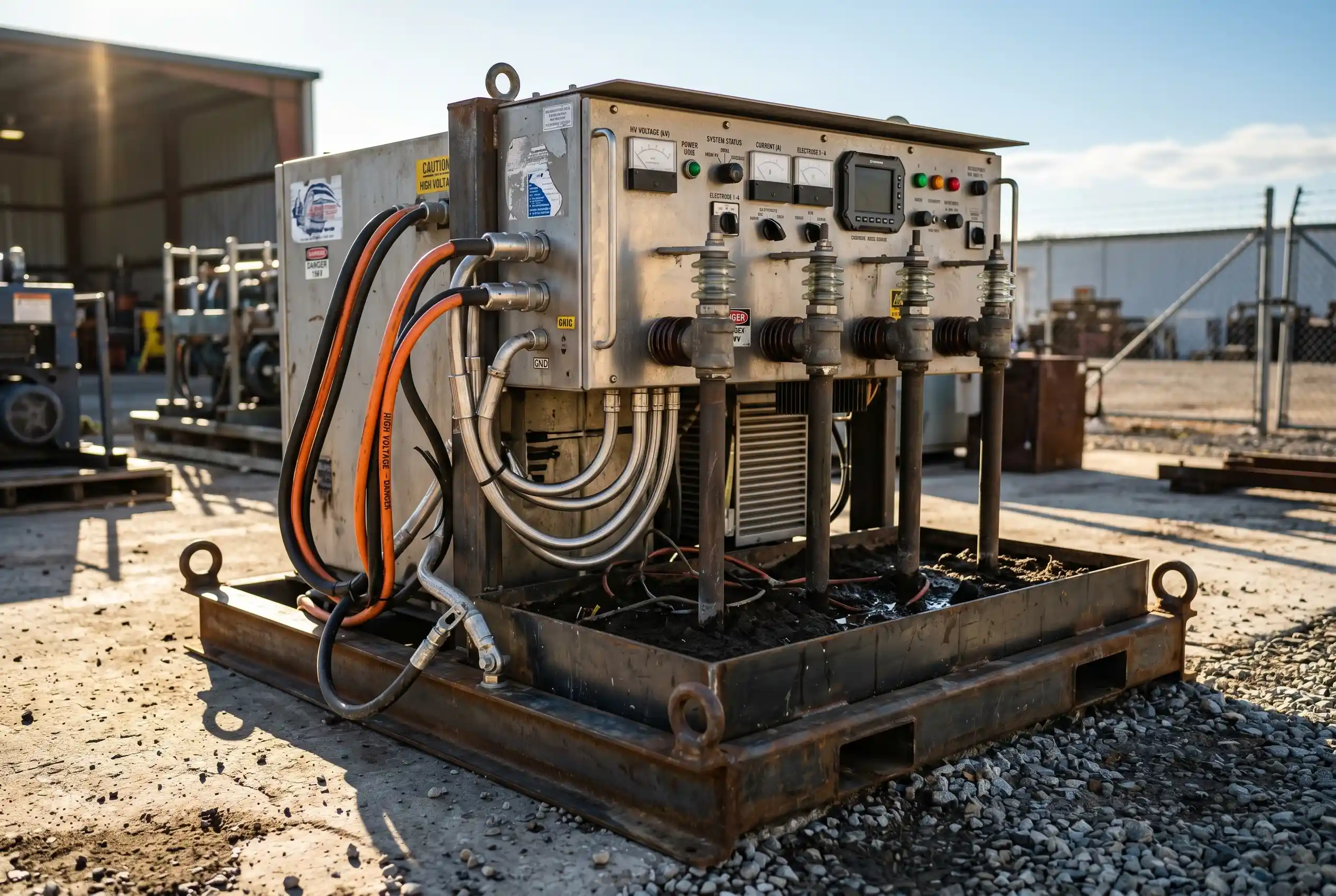
Environmental Clean Technologies (ASX: ECT) has completed construction of its pilot Rapid Electrothermal Mineralisation system, a 22-kilowatt unit the company says is the first hardware capable of destroying PFAS in contaminated soil in place, without conductive additives. The pilot is roughly 18 times more powerful than ECT’s laboratory prototype and marks the transition from bench-scale chemistry to field-deployable equipment ahead of a planned in-field demonstration in the second half of 2026.
The upgrade matters because the PFAS remediation market has long lacked a scalable, in-situ destruction technology. Current practice typically means excavating contaminated soil, shipping it, and incinerating it, a process that is expensive, carbon-intensive, and limited by disposal capacity. ECT’s system pushes high-frequency electrical current directly through the soil to break the carbon-fluorine bonds that make PFAS persist, converting them into inert, non-toxic fluoride salts.
What the Pilot System Actually Delivers
The completed pilot represents a major upgrade from ECT’s laboratory prototype, built around redesigned power electronics, industry-grade components, and aerospace-grade electrode materials meant to survive high temperatures and mechanical stress during subsurface deployment. ECT is targeting its first in-field demonstration across both soil and granular activated carbon (GAC) during the second half of 2026, subject to successful laboratory validation of the pilot hardware.
Chief technology officer Justin Sharp framed the pilot as the step that makes commercial-scale in-situ work possible.
This is the system we’ve been working towards for many years at Rice University. The step-change in power output is what unlocks in-situ soil remediation at a commercial scale, overcoming a longstanding challenge in pushing sufficient current through soil without conductive additives or fixed infrastructure, and making the technology far more commercially viable.
Sharp also highlighted the physical changes, noting the system is designed to mount on “commercially available construction and farming equipment.” The company’s technology roadmap calls for commercial partnerships to develop a pilot “remediation tractor” using existing farming technology, and eventually to scale production of autonomous remediation tractors.
Why Additive-Free Operation Changes the Math
The headline design change is the removal of conductive additives such as biochar from the treatment process. ECT’s earlier laboratory configurations relied on biochar and similar materials to carry electrical current through contaminated soil, adding both cost and logistical complexity to every remediation job.
By removing the additive step, the pilot cuts the ancillary equipment that has to be trucked to a site. That matters because PFAS-contaminated sites are often large, remote, and spread across agricultural or industrial land where hauling and staging materials is a meaningful share of project cost. ECT says additive-free, high-temperature in-situ REM has not previously been demonstrated by another PFAS remediation process.
The shift also changes the economics of scaling. A remediation crew using a tractor-mounted system does not need to source, transport, and mix biochar for every site, and does not need to clean it up afterward.
The following comparison shows how the pilot system differs from the laboratory configuration it replaces.
| Specification | Pilot System | Lab Prototype |
|---|---|---|
| Operating frequency | 170 kHz | 70 kHz |
| Operating voltage | 2,200 V | 500 V |
| System volume | ~50% smaller than lab | Baseline |
| System weight | ~75% lighter than lab | Baseline |
| Conductive additives | Not required | Biochar required |
How REM Destroys PFAS
REM is a subset of Flash Joule Heating, a technique developed at Rice University that runs high-voltage, high-power current between graphite or metal electrodes to generate temperatures above approximately 1,000 degrees Celsius inside the target material. REM applies that process to contaminated soil and to granular activated carbon loaded with PFAS.
At those temperatures, the strong carbon-fluorine bonds that give PFAS their persistence break apart. The fluorine atoms recombine into inert, non-toxic fluoride salts, which remain in the soil. ECT reports that controlled laboratory testing has achieved defluorination efficiencies exceeding 96% and removal of perfluorooctanoic acid (PFOA) of up to 99.98%.
The GAC Water Pathway
ECT is not limiting REM to soil. The same core hardware is being developed to destroy PFAS captured on granular activated carbon, the adsorbent material most water utilities use to pull PFAS out of drinking water and wastewater. Destroying PFAS-laden GAC on site would reduce reliance on the transport-and-incineration pathway that currently handles spent carbon.
The water-treatment extension is significant because it opens a larger addressable market than soil remediation alone. ECT’s REM technology overview describes a cross-application solution for land and water treatment using the same power electronics, electrodes, and control system.
Key milestones on the GAC pathway include:
- Completed laboratory validation, including a peer-reviewed study of commercial GAC samples sourced from the US Army Corps of Engineers
- Current procurement of PFAS-laden commercial samples to confirm pilot-scale results
- Potential to transform spent carbon media into higher-value carbon products, including graphene, graphite, and other advanced carbon materials
Commercialization Is a Licensing Bet
ECT does not plan to deploy REM systems directly. Instead, the company intends to commercialize the technology primarily through licensing, supported by modular integration with standard construction and farming equipment to keep site-specific capital requirements low.
The licensing model has implications for both adoption speed and revenue scale. Partners with established fleets of construction and agricultural equipment can integrate the power electronics and electrode assemblies without standing up a new manufacturing line, which lowers the barrier to first deployments. Revenue per system, however, depends on the licensing terms ECT can negotiate, terms the company has not disclosed.
What Still Has to Work
The pilot system’s completion is a hardware milestone, not a commercial one. Several things have to go right between now and the second half of 2026 field demonstration. The pilot hardware has to replicate the lab’s defluorination and PFOA removal numbers when running in actual field soil, which has variable moisture, mineral content, and electrical conductivity.
The GAC pathway has to clear the same bar with real commercial samples, not just the US Army Corps of Engineers test material. And the electrode materials, rated for high temperatures and mechanical stress, have to survive repeated subsurface cycles without degradation that would erode the economics.
The commercialization model adds its own risk. ECT is betting that construction and agricultural equipment partners will integrate the technology on the company’s licensing terms, a bet that depends on the field demo producing results clean enough to sign.
ECT’s technology update on the REM pilot system notes that safety testing and hardware validation of the pilot system are in their final stages, and that the company will assess complementary Rice University technology for PFAS remediation in water over the next three months.
Frequently Asked Questions
What is PFAS?
PFAS, or per- and polyfluoroalkyl substances, are a class of synthetic chemicals used across industrial and consumer products for decades. Their carbon-fluorine bonds make them highly persistent in the environment, which is why they are often called “forever chemicals.”
How does REM destroy PFAS?
REM runs high-voltage, high-power electrical current through contaminated soil or PFAS-loaded granular activated carbon, generating temperatures above approximately 1,000 degrees Celsius. Those temperatures break the carbon-fluorine bonds in PFAS and convert the fluorine into inert, non-toxic fluoride salts.
What is additive-free operation?
Earlier REM laboratory configurations used conductive additives such as biochar to carry current through soil. The pilot system removes that requirement, cutting the ancillary equipment needed on site and lowering the cost and complexity of large-scale deployment.
When will the field demonstration happen?
ECT is targeting its first in-field demonstration across both soil and GAC during the second half of 2026, subject to successful laboratory validation of the pilot hardware.
How is REM different from incineration?
Current PFAS remediation practice typically involves excavating contaminated material, transporting it, and incinerating it. REM is designed to treat soil in place, without excavation or transport, and without the carbon footprint of hauling and burning contaminated material at a dedicated facility.
Who developed the underlying technology?
REM is a subset of Flash Joule Heating, developed at Rice University. ECT acquired the PFAS remediation application of the technology and is commercializing it primarily through licensing.


South Korea Retail Investors Face Reckoning After KOSPI AI Rally Collapses

Surrey AI Maps Three Heart Attack Paths and Their Molecular Roots

Germany Locks Neutral Apple ATT Prompts Across Most of Europe

Apple’s 5% EU Fee Quietly Rewrites Alternative App Store Math

Apple’s EU Fee Truce Cuts Complexity but Leaves Rivals Fuming

Pixel 11 Pro Fold Trades Thinness for Durability and Seven-Year Stay

Mayo AI Flags HCM Obstruction From Everyday Ultrasound Videos

Indian Brands Quietly Scale Landmark Screens and Home Tech

Navin Vatsa Turns Grief Into a Lifetime of Quiet Seeing

Google Bets Pixel 11 Agentic AI Will Redefine Phones

Oracle Cuts 21,000 Jobs in a Year, Cites AI in 10-K Filing

Fable 5 and Mythos 5 Return as US Lifts Anthropic Export Controls

SpaceX’s Google Deal Turns a Rocket Company Into a Cloud Landlord

CD Projekt Red Co-CEO: Redemption Arc Isn’t Done, Witcher 4 in 2027

XPL Rallies 30% Ahead of Plasma One Card Tier Launch

Google Search Profiles Build a Follow Graph Inside Discover

DGO App Brings Rs 549 Mobile Pass for FIFA World Cup 2026 in Nepal

Moonshot AI Targets $30 Billion in China’s Fastest AI Funding Sprint

Oppo’s ColorOS 17 Eligibility List Leaves A-Series Buyers Behind

Microsoft Xbox Layoffs Start in July as Sharma Slams 3% Margin
-
 AI2 months ago
Oracle Cuts 21,000 Jobs in a Year, Cites AI in 10-K Filing
-
 AI2 months ago
Fable 5 and Mythos 5 Return as US Lifts Anthropic Export Controls
-
 AI3 months ago
SpaceX’s Google Deal Turns a Rocket Company Into a Cloud Landlord
-
 GAMING2 months ago
CD Projekt Red Co-CEO: Redemption Arc Isn’t Done, Witcher 4 in 2027
-
 CRYPTO3 months ago
XPL Rallies 30% Ahead of Plasma One Card Tier Launch
-
 NEWS3 months ago
Google Search Profiles Build a Follow Graph Inside Discover
-
 APPS3 months ago
DGO App Brings Rs 549 Mobile Pass for FIFA World Cup 2026 in Nepal
-
 AI3 months ago
Moonshot AI Targets $30 Billion in China’s Fastest AI Funding Sprint