
APPS
Gaeilgeoir AI Sells a Pocket Gaeltacht to Parents
Gaeilgeoir AI pitches Irish homework help, yet census figures and a new state hub show the real gap is parents who cannot speak Gaeilge at home.

Gaeilgeoir AI is pitching a pocket Gaeltacht to parents who cannot help with Irish homework. The Dublin app went to Android in December 2025, and the June 2026 push framed it as a fix for lapsed school Irish and for households that never had any. The person who has to pay, tap, and speak is the adult at the table.
That adult is also the person the census, the exemption lists, and a new Department of Education hub keep describing. The child brings home the worksheet. The gap is older than the worksheet.
Friends Who Could Not Help With Homework
Daithí de Bret, founder of Gaeilgeoir AI, has said the product started with friends from non-Irish backgrounds who felt anxious about raising children here. Most of that worry, he noticed, sat on one point: they could not understand Irish. The June 2026 homework framing, and an earlier look at Gaeilgeoir’s homework pitch, put that anxiety on a kitchen table copybook.
He had already said the quiet part in 2024. The company, founded in Dublin that year and still listed as bootstrapped with a handful of staff, was not built as a way through the national curriculum, the place where most people’s spoken Irish begins and ends.
I saw firsthand how a close friend, a parent with limited Irish, yearned to connect with their children’s language journey but felt they lacked the resources to do so. Recognising this common experience, I wanted to create a solution. Gaeilgeoir AI is about empowering families, bridging gaps, and making this beautiful language accessible to everyone.
Daithí de Bret, founder, Gaeilgeoir AI
He wanted adults comfortable ordering food, making small talk, or asking for directions in Irish. Homework is the pain that sells the download. Spoken Irish at home is the job he named.
Census Irish Is Mostly a School Language
The Central Statistics Office’s Census 2022 language profile is the cold version of that kitchen-table scene. 1,873,997 people aged three and over said they could speak Irish, 40% of that age group and 112,577 more than in 2016. Ability is not the same as use, and use is not the same as ease.
IRISH ON THE CENSUS, 2022
| Measure | Figure |
|---|---|
| People aged 3+ who can speak Irish | 1,873,997 |
| Share of that age group | 40% |
| Speak Irish very well | 195,029 (10%) |
| Speak Irish well | 593,898 (32%) |
| Do not speak Irish well | 1,034,132 (55%) |
| Daily speakers outside education | 71,968 |
| Weekly speakers | 115,065 |
| Only inside the education system | 553,965 |
| Can speak Irish but never do | almost 473,000 |
| Gaeltacht daily speakers | 20,261 |
Of those speakers, 71,968 people spoke Irish daily outside the education system, down 1,835, or 2%, from 73,803 in 2016. Another 553,965 used it only in school or college. Almost 473,000 said they could speak it and then said they never did.
Among people who claimed the language, 55% said they could not speak it well. One in ten, 195,029 people, said they spoke it very well. In Gaeltacht areas, 65,156 residents aged three and over said they could speak Irish, and 20,261 spoke it daily, 31% of those speakers. The share of Gaeltacht residents who are Irish speakers fell to 66%, from 69% in 2011.
That is the pool Gaeilgeoir is fishing. It is full of adults who ticked “yes” on a census form and still freeze when a second-class reader comes out of a schoolbag.
What the Pocket Gaeltacht Puts on the Phone
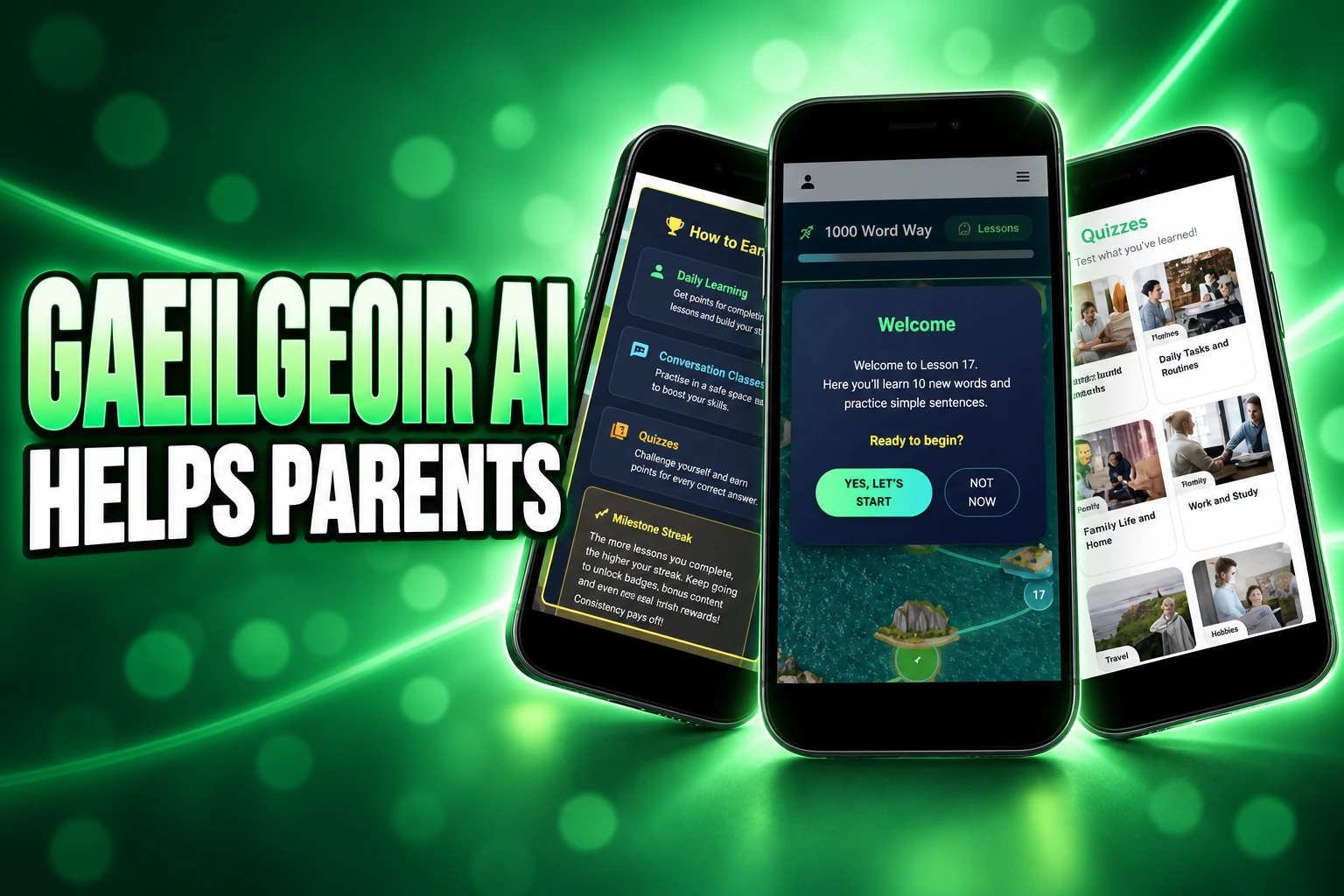
The company’s own homepage does not lead with homework. It tells learners to bring a little of the Gaeltacht with you, then stacks lessons, a 1,000 Word Way vocabulary path, conversation drills, quizzes, songs, podcasts and videos. Android is live. An iPhone app is still listed as coming soon.
WHAT GAEILGEOIR PUTS ON THE PHONE
- Spoken drills: An AI partner runs everyday scenes so you answer in Irish without another person waiting on you.
- The 1,000 Word Way: Vocabulary is laid out as a path rather than a loose list, with saved words you can replay.
- Song practice: Lessons use tracks such as Mo Ghile Mear and Óró, ‘Sé do Bheatha ‘Bhaile so phrases stick to a tune.
- Extra audio: Dozens of Irish podcasts and a video library sit beside the drills for days you will not open a lesson.
- The till: A three-day trial, then €14.99 a month or €119.88 a year, which the firm prices as €9.99 a month and a €60 saving on twelve monthly bills.
A 25% code, START25, was on the site when we read it. On Google Play the developer, listed at Parkgate Place in Dublin 8, declared that the Android app collects no data and shares none with third parties. That claim matters later, when the grammar research turns to who holds Irish text.
On 12 September 2026 the company’s own account put the method in one feed post: you do not learn a language by memorising grammar rules, you learn it by using it to communicate.
You don't learn a language by memorizing grammar rules. You learn it by using it to communicate. That's the heart of communicative language learning, where real conversation comes first and confidence grows with every exchange. #LearnIrish #Gaeilge #SpeakIrish https://gaeilgeoir. pic.twitter.com/MfX0w4Afa5
— Gaeilgeoir (@gaeilgeoir_ai) September 12, 2026
Leaving Cert oral practice is on the marketing pages too. The paid user the June story named is still the parent who cannot parse the homework, and the adult who has not spoken Irish since the exam.
Minister Naughton Launched a Free Parent Hub
On 9 September 2026 the state walked onto the same patch of ground. Minister for Education and Youth Hildegarde Naughton launched an Irish for Parents resource hub with TV presenter Síle Seoige, at an event shared by St John the Apostle Knocknacarra National School and Gaelscoil Mhic Amhlaigh in Galway. Gaeloideachas built it with Foras na Gaeilge, paid for under the Action Plan for Irish in English-Medium Schools and the policy on Irish-medium education outside the Gaeltacht.
HOW PARENT IRISH MOVED IN PUBLIC
- 2024: Gaeilgeoir AI is founded in Dublin as a conversation tutor for adults.
- December 2025: The Android app goes live on Google Play.
- 18 June 2026: The product is framed as homework help for parents with lapsed Gaeilge or none at all.
- 9 September 2026: The Department launches Irish for Parents and says fluency is not required to help a child.
The notes to editors are blunt. The hub is for families with little or no Irish and for fluent homes. The line underneath is that parents do not need to be fluent to support a child’s Irish. Bláthnaid ní Ghréacháin, chief executive of Gaeloideachas, said families arrive with different confidence and different needs, and that the site is meant to put scattered resources in one place.
One of my priorities as Minister is to build greater confidence in spoken Irish among young people. We want students to leave school feeling comfortable and confident speaking Irish, not simply studying it. This new hub will provide practical, accessible resources to help families support Irish at home, regardless of their own level of fluency.
Hildegarde Naughton, Minister for Education and Youth, 9 September 2026 launch
Conradh na Gaeilge welcomed the hub the next day. Official Ireland is now telling parents they can help without being speakers. Gaeilgeoir is telling the same parents they can become speakers for €9.99 a month on the annual plan. Those are two different bets on the same adult.
💬 An bhfuil suim agat Gaeilge a labhairt le do chuid páistí?
Tá Gaeilge do Thuismitheoirí ar fáil ar líne anois ag https://t.co/v21DKXDS9U pic.twitter.com/CxnGJdWqY2
— Government of Ireland (@GovIE) September 9, 2026
Why Children Already Open a Chatbot First
The homework panic is not waiting for a specialist Irish app. EU Kids Online, a research network run from the University of Oslo, surveyed more than 28,000 children aged 10 to 16 across 19 countries, including 805 in Ireland. Among Irish children who had used AI, 19% said they used it to write essays or stories for school, and to summarise long texts.
Ireland sat near the bottom of that homework-AI list, with Malta at 15% and Finland at 14%, against 48% in Belgium and 47% in Portugal. 57% of the Irish sample had not used any AI tool in the previous month. The worksheet is already leaking toward generic chatbots in a minority of homes. A dedicated Irish tutor is trying to stand in that gap before ChatGPT becomes the default Gaeilge teacher.
THE HOMEWORK STACK CHILDREN ALREADY HAVE
- Generic chatbots: One in five Irish children in the EU Kids Online sample who used AI had already put school writing through it.
- A specialist app: Gaeilgeoir sells Irish conversation, pronunciation and, on its exam pages, oral practice.
- A free state hub: Irish for Parents collects phrases, guidance and activities and tells adults they do not need to be fluent.
- The old route: A parent who still has school Irish, a relative, or a paid tutor sits with the copybook.
If the parent cannot check the output, the child only needs an answer that looks right. That is a different product from a parent who is learning to say the sentence aloud.
Open-Source Models Guess at Irish Verbs
Josh McGiff, a University of Limerick researcher writing with colleagues at UCC, ran an Irish grammar test on AI models that forced a choice between a correct sentence and a broken one. Fluent speakers beat both the closed models and the open ones on every task. OpenAI’s GPT-5, the best of the set, was 17% worse than those speakers. Open-source models were about 40% worse, close to a coin toss.
People and machines also failed in different places. Speakers tripped on nouns and cases, the difference between bun na sléibhte and bun na tsléibhte. The models tripped on verbs and negation, and on the autonomous past without séimhiú. McGiff warned that dropping untested systems into Irish services could water down the language children then copy.
Put simply, using existing AI tools for Irish will not be a silver bullet for solving the language inequality challenges that exist in this country.
Josh McGiff, University of Limerick, on the UL and UCC grammar study
That study measured general models, not Gaeilgeoir’s tutor. It still describes the homework shortcut already in children’s pockets. A specialist Irish app that declares it collects no data is making a different privacy claim from a global chatbot. It has not published a public score on the same grammar battery, so the kitchen-table risk is unchanged: if the adult cannot hear a wrong verb, the phone becomes the fluent one in the room.
De Bret’s 2024 brief and the Department’s 2026 hub agree on the neglected party. School Irish produced a huge count of people who can tick a box and a tiny count who speak every day. A pocket Gaeltacht is a subscription sitting in that gap. Irish for Parents is a free site that says the parent may stay rusty. Neither object replaces a person willing to say the sentence out loud, which is still the only test the census cannot fake.

Instagram Plus Tests a Read-Only Mode That Cuts Stories

Altman Asks the Public to Accept Some AI Harm

Google Freezes OSS VRP Product Reports After AI Flood

AI Agents Make Payment Rails the Scarce Prize

Turkey’s Crypto Boom Now Runs Through Three Banks

Fable 5 Came Back Under a Commerce On-Off Switch

Google’s SpaceX GPU Lease Has a Sept. 30 Deadline

Plasma One’s XPL Locks Face a 1.81 Billion Cliff

DGO’s Rs 549 World Cup Pass Cost Fans Sleep and Data

Moonshot AI’s $30 Billion Ask Became a $35 Billion Close
-
 AI4 months ago
Fable 5 Came Back Under a Commerce On-Off Switch
-
 AI4 months ago
Google’s SpaceX GPU Lease Has a Sept. 30 Deadline
-
 CRYPTO4 months ago
Plasma One’s XPL Locks Face a 1.81 Billion Cliff
-
 APPS4 months ago
DGO’s Rs 549 World Cup Pass Cost Fans Sleep and Data
-
 AI4 months ago
Moonshot AI’s $30 Billion Ask Became a $35 Billion Close
-

 NEWS4 months ago
ColorOS 17 Device List Spans Oppo, OnePlus and Realme
-

 GAMING4 months ago
Xbox Cuts 3,200 Jobs After Five Years of Thin Returns
-

 GAMING4 months ago
The RTX 4050 Under Rs 70,000 Hides a Wattage Gap