
NEWS
iPhone Ultra Becomes Duo and Repeats the X Wait
Apple put iPhone Duo on the September 9 stage, then set October 16 pre-orders, repeating the iPhone X gap the Ultra rumors never priced in.

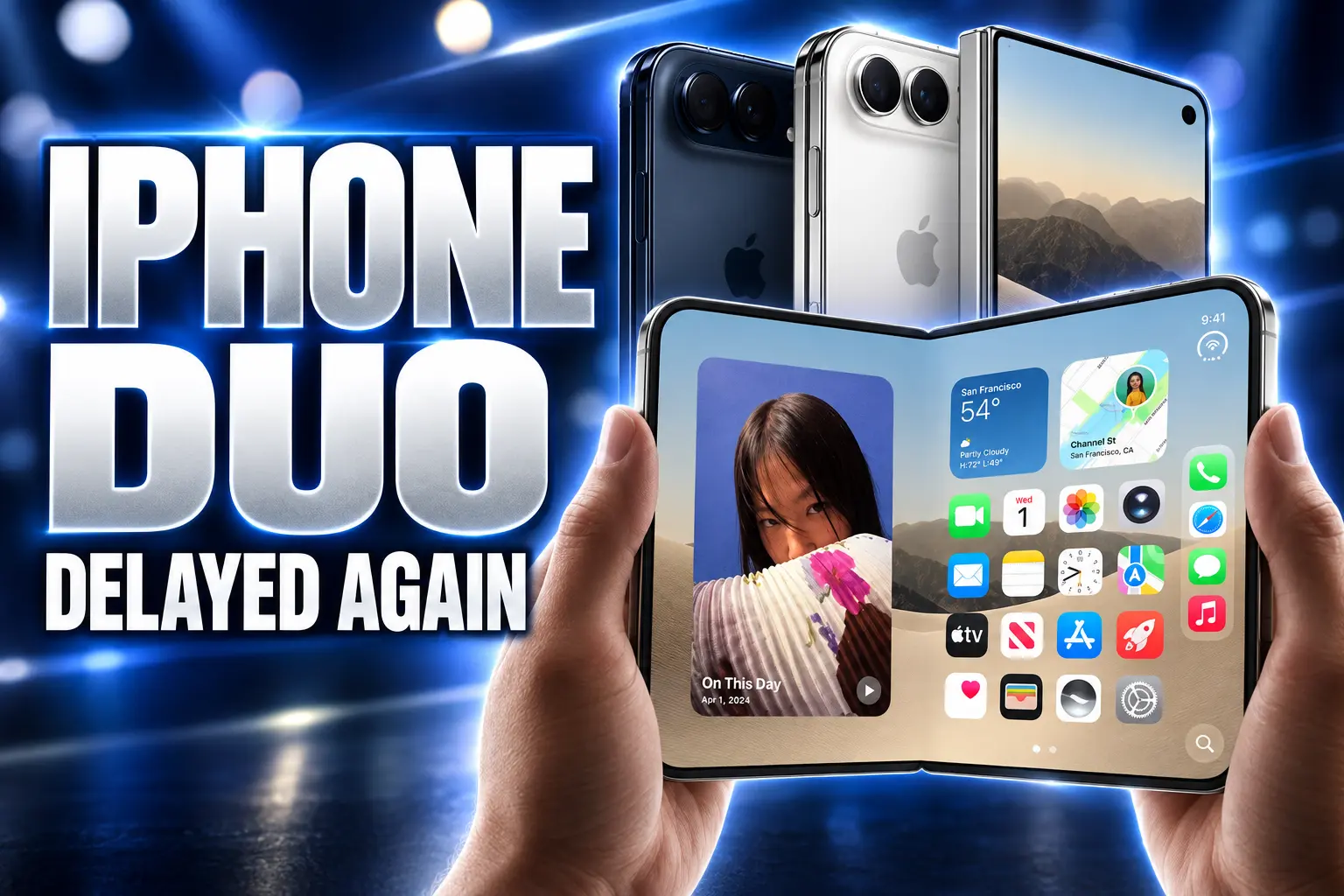
Apple unveiled iPhone Duo, its first foldable, on September 9, then set store sales for October 23 at a $1,999 starting price. The phone the supply chain spent a year calling iPhone Ultra is a book-style slab in Star White or Night Sky, with a 7.6-inch inner display and a 5.4-inch cover screen.
Late-July mass production had been read as a September green light next to iPhone 18 Pro. It bought Apple the stage. It did not buy a September shelf.
Apple Named It Duo and Set an October Store Date
John Ternus, Apple’s new chief executive, introduced the foldable as iPhone Duo, not Ultra, at the September 9 event in Cupertino. Closed, Apple says it is about the size of a passport. Open, the inner Super Retina XDR panel is 50 percent larger than iPhone 18 Pro Max. The cover display holds 90 percent of the screen area of iPhone 18 Pro. Both panels share one aspect ratio, peak at 3000 nits, and use ProMotion and Always On.
iPhone Duo is the most transformational change to iPhone since the original.
John Ternus, CEO, Apple newsroom
Apple’s pricing sheet starts at $1,999 for 256GB, then 512GB, 1TB, and 2TB, or $83.29 a month for 24 months. That is $800 above iPhone 18 Pro, which starts at $1,199. iPhone 18 Pro Max starts at $1,299. Duo buyers also get a $79 two-part case and a $129 folio with a kickstand if they want Apple’s own covers.
The store calendar is the part the Ultra notes never closed. Apple says pre-orders begin Friday, October 16 at 5 a.m. PT, with availability on Friday, October 23, in more than 70 countries and regions. Another 28 markets follow on Friday, October 30. The software on the box is iOS 27.1, not the iOS 27 build that landed on Monday, September 14.
Late July Mass Production Was a Keynote Plan
By late June, officials in Apple’s Korea and Taiwan supply chain said the foldable’s display, body, and mechanical parts were locked and that Foxconn would take the first assembly batch. A trial run had already been held in April. Those same people pointed to a late-July mass-production window and treated a September unveil as intact.
That sequence is how Apple gets a new form factor onto a fall keynote. It is not how it fills stores. Samsung Display had cleared Apple’s panel-yield bar, with officials putting final yields above 80 percent against a 70 percent floor, and had started back-end work in Vietnam on an initial run of about three million foldable OLED modules. Assembly is a slower machine than panels.
THE FOLDABLE’S ROAD TO A STORE DATE
- April 2026: First trial production tests the line before output rises.
- June 24, 2026: Supply-chain officials say specs are frozen, Foxconn has the first batch, and most hinge defects are contained.
- Late July 2026: Mass production is set to start.
- September 9, 2026: Apple names the phone iPhone Duo on stage.
- September 12, 2026: iPhone 18 Pro pre-orders open at 5 a.m. PT.
- October 16, 2026: iPhone Duo pre-orders open at 5 a.m. PT.
- October 23, 2026: iPhone Duo reaches stores.
From the June notes to the keynote was 77 days. From the keynote to Duo pre-orders is 37 days. The July start was enough time to film a launch. It was not enough time to treat the foldable like a Pro phone.
The iPhone X Wait Is Back on the Calendar
Apple has run this split before. On September 12, 2017, it put iPhone X on stage with iPhone 8 and iPhone 8 Plus, then held X back while the conventional models sold. The 2017 newsroom notice put iPhone X on pre-order beginning Friday, October 27, with stores opening Friday, November 3. That was 45 days from the keynote to pre-order and 52 days to a shelf.
THREE APPLE LAUNCH CALENDARS
| Device | Announced | Pre-orders | In stores |
|---|---|---|---|
| iPhone X | September 12, 2017 | October 27, 2017 | November 3, 2017 |
| iPhone 18 Pro | September 9, 2026 | September 12, 2026 | September 18, 2026 |
| iPhone Duo | September 9, 2026 | October 16, 2026 | October 23, 2026 |
Duo’s wait is shorter than X’s, not a copy of the six-week gap. Pre-orders sit 37 days after the keynote, and stores sit 44 days after it. The rhyme is the split: the hard new phone shares the stage with the Pro line, then sells later. iPhone 18 Pro pre-orders opened Saturday, September 12, at 5 a.m. PT. That phone reaches stores on Friday, September 18, with a second wave of 20 countries on September 25.
Kuo’s Fall Shipment Slice Was Tiny
Ming-Chi Kuo, an analyst at TF International Securities, published a July survey that already described this ending. He put second-half assembly shipments of the foldable at 7-8 million units, with only 0.5-1 million of those in the third quarter. He compared that with 20-22 million iPhone 18 Pro and Pro Max units in the same quarter, a pile he said already met the inventory bar for a normal launch. The foldable did not.
THE VOLUME GAP KUO FLAGGED
- Foldable, Q3: 0.5-1 million assembled units, about a tenth of the year’s second-half total.
- Foldable, 2H: 7-8 million units through the end of 2026.
- 18 Pro line, Q3: 20-22 million units, enough for a standard on-sale.
- His read: Announce with the Pro phones, open the foldable store later, as with iPhone X.
Kuo also warned that once pre-orders opened, lead times could stretch to 4-6 weeks or longer and stay there through December. That clock starts on October 16, not September 9. He expected the phone to sell through even at the $2,300 to $2,500 band he was using in July. Apple came in under that band at $1,999, which tightens supply math rather than loosening it.
The public fight has already left the old delay rumor. People are arguing over whether a $1,999 book phone with a covered hinge is late to foldables or the first one that looks finished when it is shut. Samsung fans want a flex-mode trick. Apple sold a passport-sized slab and a later date.
The Hinge Apple Spent the Summer Fixing
The June notes did not claim the hinge was easy. A Taiwanese official said slight noise showed up after durability tests that ran through millions of folds, and that some assembly steps ran with wider tolerances than planned, which lifted the defect rate. “Most of these problems have been solved,” that official said. The modules were assigned to Taiwan’s Shin Zu Shing and U.S.-based Amphenol, using 3D-printed parts.
Noise After Millions of Folds
That is the failure mode every first foldable inherits: a crease you can see, a tick you can hear, a gap you can feel. Apple’s answer on stage was not a fold-count marketing number. It was a mechanical stack and a software rule that keeps controls off the spine when the book is half open.
Apple’s 100-Piece Answer
WHAT APPLE PUT IN THE HINGE
- Part count: The hinge is built from more than 100 components so it can hold the inner display flat and control the open and close.
- Cover: A 3D-printed hinge cover in 100 percent recycled titanium sits against a mirror-polished grade 5 titanium frame.
- Closure: A magnet array is meant to snap the book shut with a firm close.
- Inner stack: High-strength glass sits above and below the folding panel, with adhesives that let the layers slide like pages so the panel is not forced to stretch.
- Skin: A nano-texture polymer layer, which Apple says is up to 40 percent stiffer than other cover materials in the category, cuts glare and is meant to hide the crease.
- Rating: The phone is IP68 for splash, water, and dust, with Ceramic Shield on the back and Ceramic Shield 2 on the outer display, listed at 3x better scratch resistance than the prior generation.
Unlock is Touch ID in the side button, plus Apple Watch, because Face ID does not span both poses. An under-display FaceTime camera sits under the inner panel. Later this year Apple says Duo will take Apple Pencil with USB-C on either screen. That does not change the factory fact: a 100-piece hinge is why July production supported a keynote and still left October on the calendar.
Why iPhone Duo Misses the September 18 Shelf
iPhone 18 Pro is already in the buy queue. Duo is not. The gap from Pro store day on September 18 to Duo store day on October 23 is 35 days. Apple is running two fall iPhone seasons a month apart, and it built a software bridge for people who will own both: iPhone Handoff, in iOS 27, lets a user move one number between two iPhones on supported carriers.
Duo uses the same A20 Pro chip as the Pro models, built on a 2-nanometer process, with a custom vapor chamber and a dual-battery pack, one cell on each side. Apple rates the 6-core CPU as up to 20 percent faster than A19 Pro, the 7-core GPU and memory bus as up to 40 percent faster and 50 percent wider, and sustained performance as up to 35 percent better than iPhone 17 Pro. The Dual 16-core Neural Engine is listed at 2x the compute of the last generation. Video playback is up to 31 hours on the inner display, up to 44 hours on the outer display, and up to 24 hours when both screens are used equally. A wired charge can hit 50 percent in about 20 minutes; MagSafe or Qi2 is about 30 minutes to the same mark.
The cameras are a 48MP Fusion Main with 2x optical-quality telephoto and a 48MP Fusion Ultra Wide, plus a 12MP Center Stage camera on the cover. Smart Take, Duo Preview, Kid Cue, and Duo FaceTime are the features that only exist because there are two faces. The phone is eSIM-only worldwide, with Apple’s C2 modem and N1 wireless chip. Recycled content is listed at 35 percent of the device by mass, including 100 percent recycled cobalt in the batteries.
Pre-orders open at 5 a.m. PT on Friday, October 16, in more than 70 countries and regions.

The Yemen Cell Kept Claude’s Flight Code After the Ban

Unofficial AI Pages Beat Marshall County’s Sheriff to Every Scare

The SEC Crypto Rule Leaves Exchanges Still Exposed

Brian Bengs Bets His Senate Race on an AI Stop

Agentic Workflows Turn Cheap Tokens Into Larger AI Bills

Fable 5 Came Back Under a Commerce On-Off Switch

Google’s SpaceX GPU Lease Has a Sept. 30 Deadline

Plasma One’s XPL Locks Face a 1.81 Billion Cliff

DGO’s Rs 549 World Cup Pass Cost Fans Sleep and Data

Moonshot AI’s $30 Billion Ask Became a $35 Billion Close
-
 AI3 months ago
Fable 5 Came Back Under a Commerce On-Off Switch
-
 AI4 months ago
Google’s SpaceX GPU Lease Has a Sept. 30 Deadline
-
 CRYPTO4 months ago
Plasma One’s XPL Locks Face a 1.81 Billion Cliff
-
 APPS4 months ago
DGO’s Rs 549 World Cup Pass Cost Fans Sleep and Data
-
 AI4 months ago
Moonshot AI’s $30 Billion Ask Became a $35 Billion Close
-

 NEWS4 months ago
ColorOS 17 Device List Spans Oppo, OnePlus and Realme
-

 GAMING4 months ago
Xbox Cuts 3,200 Jobs After Five Years of Thin Returns
-

 GAMING3 months ago
The RTX 4050 Under Rs 70,000 Hides a Wattage Gap