
GADGETS
Apple’s Foldable iPhone Launches in September as Glasses Slip to 2027
Apple’s 2026-2027 hardware roadmap brings a foldable iPhone in September, redesigns the iPhone for its 20th anniversary in 2027, and delays smart glasses to late 2027.

Apple’s 2026-2027 hardware roadmap puts a foldable iPhone in stores by September and a redesigned iPhone for the line’s 20th anniversary in 2027, while pushing Apple’s first smart glasses to late 2027. The slip on glasses gives Meta another cycle to define the category. The foldable, by contrast, has IDC’s December 2025 forecast calling for Apple to capture 34% of foldable category value in its first year on a 22% unit share and a $2,400 average selling price. Bloomberg’s Mark Gurman, who has tracked Apple’s roadmap for over a decade, told Power On that the iPhone Fold is on track for a September debut with the iPhone 18 Pro. Two years of launches now sit on the calendar.
The Foldable iPhone Lands in September
Apple has not officially announced the device. Bloomberg’s Mark Gurman calls it “the most significant overhaul in the iPhone’s history.” The foldable will sit alongside the iPhone 18 Pro and iPhone 18 Pro Max in the fall 2026 lineup, with Gurman saying on April 7, 2026 that the launch remains on track for September even as supply may be limited at debut. Apple picked a book-style design wider than it is tall, with a 4:3 aspect ratio that gives the open device an iPad mini feel.
| Vendor | 2026 foldable play | IDC forecast |
|---|---|---|
| Apple | iPhone Fold (book-style) | 22% unit share, 34% value share, $2,400 ASP |
| Samsung | Galaxy Z Trifold (Q1 2026) | Tri-fold innovation to mainstream global consumers |
| Huawei | HarmonyOS Next foldables | Shipments “almost double” in 2026 |
IDC’s December 2025 forecast puts Apple’s first-year foldable average selling price at $2,400, value share at 34%, and unit share at 22%, per IDC’s 34% foldable value-share forecast. The gap is the price premium, not the volume.
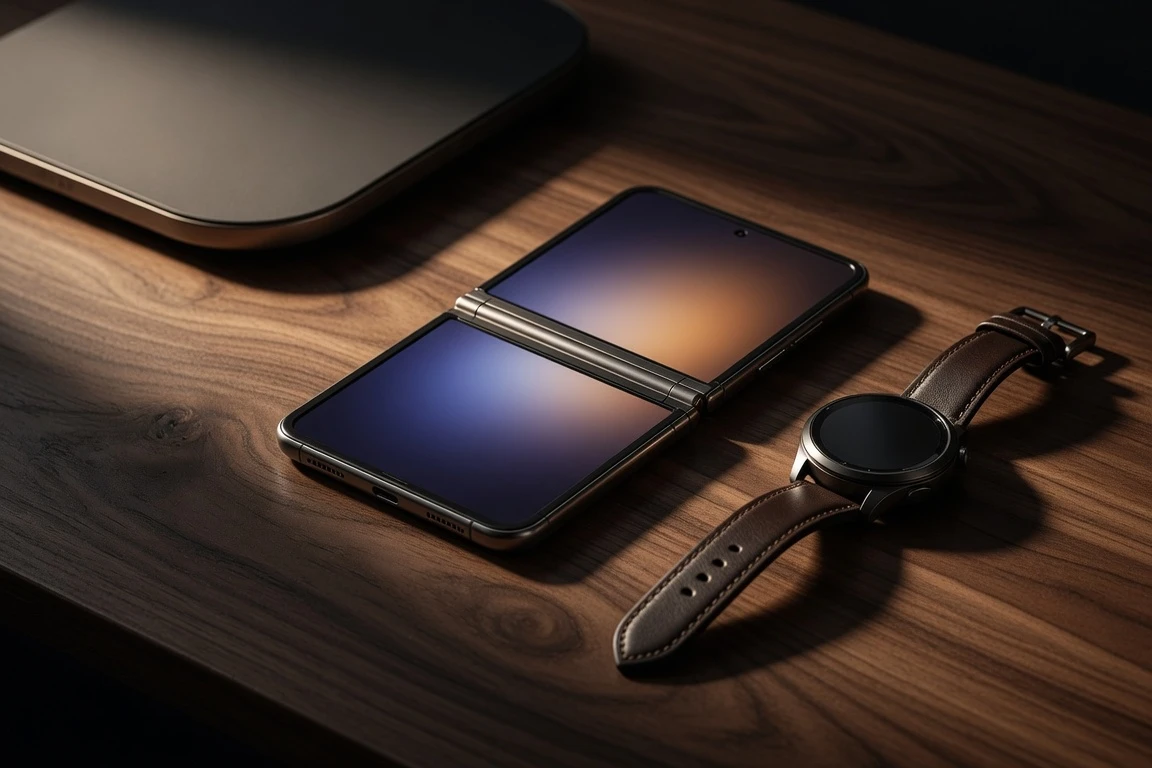
The chassis opens to a 7.8-inch OLED display and folds to a 5.5-inch outer screen. Thickness is rumored at 4.5mm when open, making it Apple’s thinnest iPhone to date. A titanium and liquid metal hinge is engineered to nearly eliminate the crease that has dogged other foldables.
iPhone 18 Pro Brings the A20 Pro Chip
The September lineup is the high-end only: iPhone 18 Pro, iPhone 18 Pro Max, and Apple’s first foldable. Per MacRumors’ recap of next year’s iPhones, the Pro moves to a smaller Dynamic Island, a variable-aperture main lens, Apple’s C2 modem, and a dark cherry special color. The A20 Pro will be Apple’s first chip on TSMC’s 2nm node. Researchers inside the iOS 27 developer beta pulled framework strings like “foldState” and “angleDegrees” with no purpose on any current iPhone, per iOS 27 beta strings tied to the foldable. iOS 27 itself launches the same day as the new iPhones, carrying the long-promised Siri overhaul.
The A20 Pro also powers the iPhone Fold and the spring 2027 iPhone Air 2. Apple is dropping the standard iPhone 18 and iPhone 18e to spring 2027, ending the once-a-year iPhone event. The split-launch pattern, fall for premium, spring for everything else, is designed to spread iPhone revenue more evenly across the calendar. Apple’s stated reason is to compete more directly with Samsung, which releases flagship phones at multiple points across the year.
The 20th Anniversary iPhone in 2027
2027 marks 20 years since the iPhone’s debut. Apple is preparing a curved-glass redesign. Per The Information, via MacRumors’ guide, the device will carry an enclosure that “curves around the device edges,” with the selfie camera moved under the display and no display cutouts at all.
Apple is sourcing a custom quad-curved Samsung Display OLED for the anniversary model, with optical refraction and light-guiding structures engineered to remove the bezels. Per analyst Jeff Pu’s note seen by 9to5Mac on May 1, 2026, the curved design is intended for the iPhone 18 Pro and Pro Max rather than a separate 20th-anniversary model. Solid-state buttons with haptic feedback have been tipped on the sides. Apple’s own description will arrive when the company chooses to show it.
A second-generation foldable iPhone will arrive alongside the anniversary model in fall 2027. Per Apple’s spring 2027 iPhone Air refresh coverage, staggering releases across fall 2026, spring 2027, and fall 2027 lets Apple keep a major iPhone launch in roughly every six-month window.
AirPods With Cameras and the Smart Glasses Slip
Apple is testing AirPods with cameras built into longer stems, with a small LED that lights up when they are active. Bloomberg’s Mark Gurman reports the cameras “essentially act as eyes for the Siri digital assistant and aren’t designed to take photos or video.” Hardware is nearly ready; the launch waits on Siri.
The cameras feed into Apple’s visual intelligence system, the same one that already powers how Visual Intelligence works on iPhone, rather than serving as a media capture device. That sets the AirPods apart from the photo-first pitch of Meta’s Ray-Ban smart glasses, and it explains why Gurman describes turn-by-turn directions and contextual reminders as core use cases.
The idea is to let users ask questions about an item they might be looking at. Apple has also been working on other uses for the AI cameras. The device could give the wearer a reminder based on something the camera sees, or it might use external visuals to provide more advanced turn-by-turn directions. The AI could cite a specific landmark ahead when telling users when they should turn.
Mark Gurman is the Bloomberg reporter who has covered Apple’s roadmap for over a decade. The quote appears in his reporting on Apple’s camera-equipped AirPods prototypes, as published by the Thurrott newsletter.
Apple’s smart glasses are now slated for late 2027, slipping from an earlier early-2027 target. Glasses will compete with Meta’s Ray-Bans in the $200-$500 range. Per Gurman, the delay is tied to unspecified development roadblocks, not a strategic retreat.
The glasses will pair with an iPhone rather than run standalone. Plastic frames will come in at least four designs, including Wayfarer-style rectangular and Tim Cook-style slim, with colors in black, ocean blue, and light brown; cameras will be vertically-oriented ovals. No in-lens augmented reality display is expected for at least a few years. CEO Tim Cook has named the glasses his top priority before handing the CEO role to John Ternus on September 1, per Gurman.
Apple TV, HomePod mini, and the New Home Hub
Apple has held back the next Apple TV 4K and HomePod mini specifically to tie them to the new Siri in iOS 27, according to Gurman. Both are now slated for fall 2026. The Apple TV moves from the A15 chip to the A17 Pro, and the HomePod mini from the S5 to the S9.
- $2,400: IDC’s forecast average selling price for the iPhone Fold in its launch year
- 4.5 mm: the thickness the iPhone Fold is rumored to hit when open, per MacRumors
- 34%: IDC’s forecast value share of the foldable category for Apple in year one
- 22%: IDC’s forecast unit share of the foldable category for Apple in year one
- $200-$500: the U.S. price band Apple smart glasses will compete in, per Bloomberg
- Late 2027: the new target for Apple’s first smart glasses, per Bloomberg
The HomePod mini’s S9 chip cannot run Apple’s AI models locally, so any new Apple Intelligence features on it will rely on cloud streaming, per what Apple Intelligence does on supported devices. The Apple TV’s A17 Pro gives it the headroom to run models locally. A refreshed Siri Remote may ship with the box. Apple’s Home Hub, a 7-inch iPad-like display, will come in two versions: one designed to mount on the wall, one with a speaker base that looks like a HomePod mini. The Home Hub is the spine of the new Siri experience across Apple’s home lineup.
Mac, iPad, and the Tabletop Robot
The Mac side of the roadmap centers on the M5 generation. M5 MacBook Air, M5 Pro and M5 Max MacBook Pro, M4 iPad Air, and MacBook Neo already shipped in March 2026. Mac Studio’s M5 Max and M5 Ultra updates are pending, with MacRumors noting ongoing memory constraints.
The entry-level iPad is expected to pick up the A19 chip and Apple Intelligence support this year, becoming the cheapest iPad capable of running Apple’s AI features. That brings Apple Intelligence to a sub-$400 price point for the first time.
Further out, Apple is building a tabletop robot codenamed J595. It pairs a 7-inch iPad-like display with a thin robotic arm on a swivel base that can rotate and extend about six inches in any direction. Per MacRumors’ upcoming products guide, the device is “a more powerful version of the home hub.” Bloomberg first reported the project in August 2025 as a centerpiece of Apple’s AI turnaround. The robot is targeted for 2027, and it is the first Apple product built around a lifelike-Siri experience.
What the Roadmap Costs and Who It Favors
The two-year plan reads as a series of bets on different categories with different timing. The foldable iPhone puts Apple on top in dollar terms; the smart-glasses slip hands Meta another year to own the category; the tabletop robot is the longest-dated piece of the cycle. Samsung and Huawei get the same foldable market in 2026 Apple is entering, just with their own devices on the shelves first.
- March 2026: M5 MacBook Air, M5 Pro/Max MacBook Pro, M4 iPad Air, MacBook Neo, iPhone 17e
- September 2026: iPhone 18 Pro, iPhone 18 Pro Max, iPhone Fold, Apple Watch Series 12
- Fall 2026: Apple TV 4K (A17 Pro), HomePod mini 2 (S9), Home Hub (7-inch display), iPad 12 (A19)
- Spring 2027: iPhone 18, iPhone 18e, iPhone Air 2 (V62), second-gen AirPods Pro
- Fall 2027: 20th-anniversary iPhone (curved glass), second-gen iPhone Fold, Apple smart glasses, Apple Watch Ultra 4, tabletop robot (J595)
The foldable category is still small: IDC pegged 2025 shipments at 20.6 million units against a standard smartphone market measured in the billions. The category is set to grow 30% year over year in 2026, up from a prior 6% forecast, per IDC’s December release. Apple’s planned 34% share of value on a 22% share of units is the bet that foldables are a dollars game, not a volumes one. Per Gurman, Apple’s smart glasses product “has faced development delays,” and the company has not committed to a 2028 release if those slip again.
Frequently Asked Questions
When does Apple’s foldable iPhone launch?
Apple has not set an official date. Bloomberg’s Mark Gurman said on April 7, 2026 the device is on track for a September debut with the iPhone 18 Pro, even as supply may be limited at launch. IDC’s December 2025 forecast described the foldable arriving at year-end, and Barclays analyst Tim Long had previously pointed to December.
How much will the iPhone Fold cost?
Apple has not announced pricing. IDC expects an average selling price of $2,400 in year one, with Apple taking a third of the category’s revenue. MacRumors’ spec roundup suggests a starting price above $2,000. The figure is a projection, not an Apple quote.
When will Apple’s smart glasses ship?
Per Bloomberg’s Mark Gurman, Apple’s first smart glasses are now targeting late 2027, slipping from an earlier early-2027 target. Glasses will compete with Meta’s Ray-Bans in the $200-$500 range. Gurman says the delay is tied to unspecified development roadblocks.
What is the 20th anniversary iPhone?
The 20th anniversary iPhone is expected in September 2027. Per The Information, via MacRumors, the device will have a curved glass enclosure wrapping around the device edges, a selfie camera under the display, and no display cutouts at all. Analyst Jeff Pu expects this design to land on the Pro line rather than as a separate model.
When is Apple’s tabletop robot coming?
Apple’s tabletop robot, codenamed J595, is targeted for 2027. Per MacRumors, it pairs a 7-inch iPad-like display with a thin robotic arm on a swivel base that can rotate and extend about six inches in any direction. The device is described as a more powerful version of the home hub and Apple’s first lifelike-Siri-driven companion.


Sony’s 10 Percent Disc Drop Leaves the 2028 Cutoff Intact

Chip Allocation Sidelines the Base iPhone 18 This Fall

Miami-Dade Fights the Vice City Brand It Already Wears

IFA 2026 Awards Put Tecno Ahead of Flagship Phones

USB-C Gadgets Made the Junk Drawer Rechargeable

Pixel 11 Pro Asks $1,099 for a Light Google Locked

The iPhone Ultra Sells Two Retired Minis as One Foldable

Google Opens Gmail to Voice and Gates Docs Live

Lenovo Prices the IdeaPad Vibe Against Apple’s $699 Neo

Xbox Caps Game Pass Cloud Gaming at 15 Hours

Oracle Cuts 21,000 Jobs in a Year, Cites AI in 10-K Filing

Fable 5 and Mythos 5 Return as US Lifts Anthropic Export Controls

SpaceX’s Google Deal Turns a Rocket Company Into a Cloud Landlord

CD Projekt Red Co-CEO: Redemption Arc Isn’t Done, Witcher 4 in 2027

XPL Rallies 30% Ahead of Plasma One Card Tier Launch

Google Search Profiles Build a Follow Graph Inside Discover

DGO App Brings Rs 549 Mobile Pass for FIFA World Cup 2026 in Nepal

Moonshot AI Targets $30 Billion in China’s Fastest AI Funding Sprint

Oppo’s ColorOS 17 Eligibility List Leaves A-Series Buyers Behind

Microsoft Xbox Layoffs Start in July as Sharma Slams 3% Margin
-
 AI2 months ago
Oracle Cuts 21,000 Jobs in a Year, Cites AI in 10-K Filing
-
 AI2 months ago
Fable 5 and Mythos 5 Return as US Lifts Anthropic Export Controls
-
 AI3 months ago
SpaceX’s Google Deal Turns a Rocket Company Into a Cloud Landlord
-
 GAMING3 months ago
CD Projekt Red Co-CEO: Redemption Arc Isn’t Done, Witcher 4 in 2027
-
 CRYPTO3 months ago
XPL Rallies 30% Ahead of Plasma One Card Tier Launch
-
 NEWS3 months ago
Google Search Profiles Build a Follow Graph Inside Discover
-
 APPS3 months ago
DGO App Brings Rs 549 Mobile Pass for FIFA World Cup 2026 in Nepal
-
 AI3 months ago
Moonshot AI Targets $30 Billion in China’s Fastest AI Funding Sprint