
NEWS
iOS 27 Beta Quietly Confirms the iPhone Ultra and Touch MacBook
iOS 27 and macOS 27 betas add foldState strings, resizable iPhone Mirroring, and Sidecar touch support, pointing to a fall iPhone Ultra and MacBook launch.

Apple’s annual software betas usually preview the next iPhone and Mac software. This year they look more like a pre-launch checklist for hardware that does not exist yet. Strings in iOS 27 and interface changes in macOS 27 line up with the two products Apple has spent years resisting: the iPhone Ultra, Apple’s first foldable phone, and a MacBook with a touchscreen.
The list of hints, as flagged by Bloomberg’s Mark Gurman in his Power On newsletter covering the iOS 27 beta evidence, includes the foldState and angleDegrees references in iOS 27’s frameworks, a new key that returns the count of built-in displays, an iPhone Mirroring app that can stretch to iPad-like widths, and a Sidecar update that accepts touch input from an iPad. None of these is a confirmation on its own. Together they sketch the shapes Apple is asking developers to design for.
The Two Strings That Aren’t Nothing
Sam Henri Gold, a product designer posting on X, spotted the foldState and angleDegrees strings inside iOS 27’s framework code on June 8. A third discovery, a new key that returns the total count of built-in displays on a device, completes the picture. Gold’s post was a one-liner with a raised eyebrow: iOS 27 framework references foldState and angleDegrees but I’m sure that’s nothing.
Each string maps to a function a folding phone needs. Fold state is the answer to how open the device is at any given moment. Angle degrees reports the hinge position. A count of built-in displays is what a device with two screens reports back to the operating system. None of these would be useful on a slab iPhone.
Gurman called the trio the first real evidence for both products, per his June 14 Power On newsletter. Mark Gurman’s post flagging the iOS 27 and macOS 27 evidence links the strings to Apple’s long-rumored iPhone Fold, widely expected to ship as the iPhone Ultra.
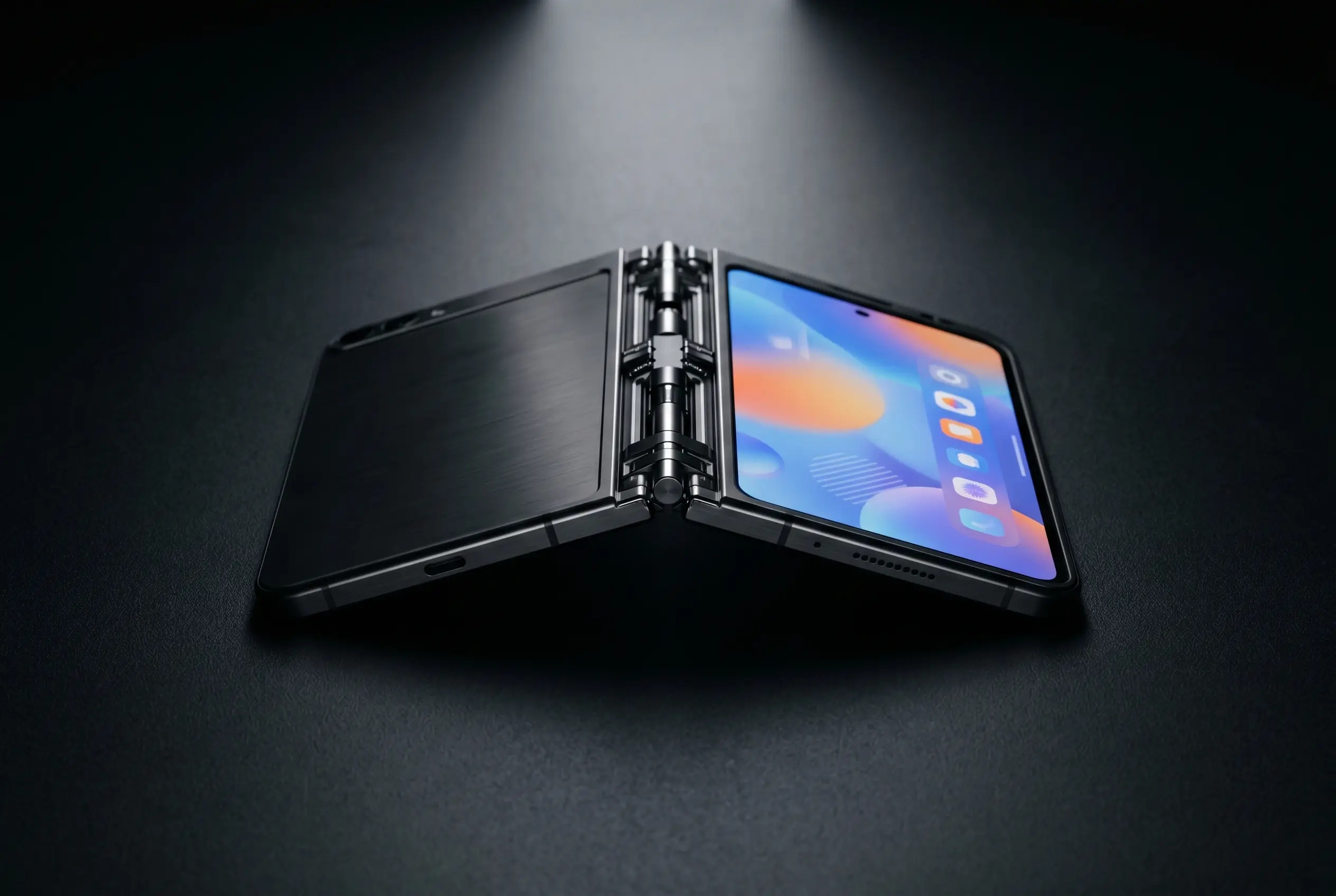
Why Apple Is Asking Developers to Think Squarer
The strings are not the only signal. At WWDC 2026’s Platforms State of the Union, Apple told developers to stop designing apps for fixed orientations and to instead target what the company called a dynamic range of sizes and aspect ratios. The framing went beyond the iPhone Mirroring and iPad contexts Apple cited on stage. Developers who rebuild against the latest SDK will have their apps automatically opted in to resizability, with SwiftUI apps that already use scene lifecycle and standard framework support for basic resizability considered well on your way to supporting full resizability. A new resizable iOS simulator and Previews in Xcode are also part of the package, along with a skill for coding agents to help identify and fix common resizability issues.
That is the kind of brief that makes sense only if a future iPhone folds open to a substantially larger inner display. The form factor of the iPhone Ultra, widely expected to be a book-style device with a roughly 7.8-inch inner display, is the squarer shape Apple is asking developers to plan for. The 5.5-inch cover display on the outside would be the more familiar iPhone-like experience. The brief, including the resizable simulator, Xcode Previews, and the coding agent skill, is what Apple published at WWDC 2026.
iOS 27 and macOS 27 are full of the first pieces of evidence that the foldable iPhone and touch-screen MacBook are close.
That line is from Gurman’s June 14 Power On newsletter, the same post that links the framework strings to a foldable iPhone and a touch Mac. Both products are expected to land at the same fall 2026 event.
The macOS 27 Touch Setup
Inside the macOS 27 beta, codenamed Golden Gate, sits a list of touch-flavored changes that go beyond what current hardware needs. Four interface changes stand out, and the macOS 27 documentation ties them to the same hardware brief. Each is the kind of small adjustment Apple ships a year ahead of a form-factor change.
The new pill-shaped Siri Search and Ask interface on the Mac is a quieter change. The pill shape could be a precursor to a Dynamic Island-style cutout on future touch MacBook models.
- iPhone Mirroring resize: the macOS 27 mirror app stretches to iPad-like widths, sized for an opened iPhone Fold’s main display
- Sidecar touch input: macOS now accepts full touch input from the iPad, in addition to extended display mode
- Pull-to-refresh: a smartphone gesture now lives inside macOS, with trackpad and mouse support
- Pill-shaped Siri Search and Ask: the redesigned Siri UI sits in the macOS menu bar
The changes line up with the hardware brief Gurman laid out in February 2026. Back then, he said the touchscreen MacBook Pro would arrive by the end of 2026 with OLED and a Dynamic Island at the top center of the screen. The macOS 27 beta is the first software drop to back that forecast up with concrete code.
What the MacBook Looks Like in the Code
Apple’s next Mac, judging by the macOS 27 code, takes more from the iPad playbook than from any previous Mac. The 14-inch and 16-inch MacBook Pro refresh on deck for the fall of 2026 would be the first Apple laptop with an OLED display, replacing the mini-LED panels Apple has used since 2021. It would also be the first Mac to ship with a Dynamic Island cutout at the top of the screen, replacing the notch the MacBook Pro has worn since 2021.
Apple’s Mac roadmap has resisted a touchscreen for years, with the company publicly saying for most of a decade that the Mac would not get one. That position has shifted, per the MacRumors MacBook Ultra recap. MacRumors notes the refresh could come as soon as late 2026, but it is looking more like Apple will hold the launch until early 2027 while it builds up stock around a chip shortage. Apple shipped M5 Pro and M5 Max models in March 2026 with the same 2021 design. Keyboard and trackpad are not going anywhere.
- Display: OLED, replacing mini-LED
- Chip: M6-series, 2nm process
- Cutout: Dynamic Island, replacing the notch
- Window: late 2026 or early 2027
The iPhone Ultra Hardware Map
The iPhone Ultra that the iOS 27 code is pointing to is the foldable Apple has reportedly been working on for years, per MacRumors. Touch ID is the rumored biometric, replacing Face ID on a device that would otherwise be Apple’s first iPhone in years without it.
$2,000+ is the starting price MacRumors puts on the device, a number that would make it the most expensive iPhone Apple has ever sold. Dummy units of the iPhone Ultra are already in production, a stage that historically signals an imminent launch. Two features that have defined the iPhone Pro line for years, MagSafe and the Action Button, are missing from the dummy units Sonny Dickson and Vadim Yuryev have shared.
7.8 inches is the size of the inner display, the largest Apple has put in any iPhone. The book-style fold puts the device in the same shape class as the Samsung Galaxy Z Fold series and similar Android foldables that have shipped for years. The iPhone Ultra would open into something close to a small iPad and close into a phone most people can still hold in one hand. The device is anticipated to be announced in September 2026 alongside the iPhone 18 Pro and iPhone 18 Pro Max.
Per IDC, Apple’s first foldable is on track to capture a third of foldable market value in its first year, per The 34% foldable-value estimate for the iPhone Fold’s first year. The $2,000+ starting price is what the rest of the foldable field would benchmark against.
- Frame: titanium
- Hinge: Liquid Metal
- Chip: A20
- Modem: Apple C2
- Form factor: book-style horizontal fold
September Arrives With a Split
Apple’s 2026 iPhone launch is the first one to land in two stages. iPhone 18 Pro, iPhone 18 Pro Max, and the iPhone Ultra are all expected in September 2026, with the standard iPhone 18 then following in spring 2027, per the MacRumors iPhone 18 roundup. The split gives Apple’s foldable launch the same window as the Pro models without forcing a single product to carry the entire flagship lineup.
The hardware pipeline for the iPhone Ultra now includes dummy units, software scaffolding in iOS 27, and a published Apple developer brief. The iPhone 18 Pro split-launch and spec breakdown covers the launch schedule with the mechanical camera iris and the 2-nanometer chip details. The first foldable is also the device that puts the company’s split-launch strategy to the test. Fall 2026 would then carry two flagship category debuts in a single quarter, with the new MacBook Pro expected alongside the iPhone Ultra.
Engineering risk is the variable. Dummy units already in production suggest the hardware is on track, but trial production has reportedly stalled on hinge reliability, per a separate post from the leaker Instant Digital. On the Mac side, MacRumors notes the touchscreen MacBook Pro could still slip from late 2026 into early 2027.
The Third Hint Was Hiding in the Home App
Power On flagged two products, but the WWDC 2026 software drops hold another hardware hint. 9to5Mac identified a third: an in-home Apple security camera with facial recognition and infrared sensors, designed to plug into HomeKit Secure Video. iOS 27’s new Home app shipped five new features, four of them tied to HomeKit Secure Video, including long-requested 4K support. That ratio of camera-related changes to overall Home changes is unusual, and 9to5Mac reads it as Apple staging the launch of its own camera.
Apple’s camera design matches the Home app changes. The device is expected to determine who is in a room using facial recognition and infrared sensors, with Apple expecting users to place cameras throughout the home to feed its home automation system. Use cases include turning lights off when someone leaves a room and automatically playing music liked by a particular family member.
Frequently Asked Questions
When is the iPhone Ultra expected to launch?
Apple is expected to announce the iPhone Ultra in September 2026 alongside the iPhone 18 Pro and iPhone 18 Pro Max, per MacRumors. The standard iPhone 18 is then expected to follow in spring 2027 under Apple’s split launch strategy.
How much will the iPhone Ultra cost?
Per MacRumors, the iPhone Ultra is expected to start at over $2,000, which would make it the most expensive iPhone Apple has ever sold.
When is the touchscreen MacBook expected?
Per Bloomberg’s Mark Gurman, the touchscreen MacBook Pro is expected by the end of 2026, complete with OLED and a Dynamic Island at the top of the screen. MacRumors notes it could slip to early 2027 due to chip shortages.
What did the iOS 27 beta actually contain?
Per MacRumors, the iOS 27 beta contains two framework strings called foldState and angleDegrees, plus a new key that returns the total count of built-in displays on a device. Apple also told developers to target a dynamic range of sizes and aspect ratios during WWDC 2026.
Will the iPhone Ultra have Face ID?
Per MacRumors, the iPhone Ultra is expected to use Touch ID instead of Face ID, alongside a titanium frame, a Liquid Metal hinge, the A20 chip, and the C2 modem.


South Korea Retail Investors Face Reckoning After KOSPI AI Rally Collapses

Surrey AI Maps Three Heart Attack Paths and Their Molecular Roots

Germany Locks Neutral Apple ATT Prompts Across Most of Europe

Apple’s 5% EU Fee Quietly Rewrites Alternative App Store Math

Apple’s EU Fee Truce Cuts Complexity but Leaves Rivals Fuming

Pixel 11 Pro Fold Trades Thinness for Durability and Seven-Year Stay

Mayo AI Flags HCM Obstruction From Everyday Ultrasound Videos

Indian Brands Quietly Scale Landmark Screens and Home Tech

Navin Vatsa Turns Grief Into a Lifetime of Quiet Seeing

Google Bets Pixel 11 Agentic AI Will Redefine Phones

Oracle Cuts 21,000 Jobs in a Year, Cites AI in 10-K Filing

Fable 5 and Mythos 5 Return as US Lifts Anthropic Export Controls

SpaceX’s Google Deal Turns a Rocket Company Into a Cloud Landlord

CD Projekt Red Co-CEO: Redemption Arc Isn’t Done, Witcher 4 in 2027

XPL Rallies 30% Ahead of Plasma One Card Tier Launch

Google Search Profiles Build a Follow Graph Inside Discover

DGO App Brings Rs 549 Mobile Pass for FIFA World Cup 2026 in Nepal

Moonshot AI Targets $30 Billion in China’s Fastest AI Funding Sprint

Oppo’s ColorOS 17 Eligibility List Leaves A-Series Buyers Behind

Microsoft Xbox Layoffs Start in July as Sharma Slams 3% Margin
-
 AI2 months ago
Oracle Cuts 21,000 Jobs in a Year, Cites AI in 10-K Filing
-
 AI2 months ago
Fable 5 and Mythos 5 Return as US Lifts Anthropic Export Controls
-
 AI3 months ago
SpaceX’s Google Deal Turns a Rocket Company Into a Cloud Landlord
-
 GAMING2 months ago
CD Projekt Red Co-CEO: Redemption Arc Isn’t Done, Witcher 4 in 2027
-
 CRYPTO3 months ago
XPL Rallies 30% Ahead of Plasma One Card Tier Launch
-
 NEWS3 months ago
Google Search Profiles Build a Follow Graph Inside Discover
-
 APPS3 months ago
DGO App Brings Rs 549 Mobile Pass for FIFA World Cup 2026 in Nepal
-
 AI3 months ago
Moonshot AI Targets $30 Billion in China’s Fastest AI Funding Sprint