
AI
Olix Raises $312M to Crack AI Inference With Specialist Chips
UK startup Olix triples valuation to $3.3B with specialist decode accelerators and optical links that dodge HBM shortages, adding Nick McKeown to the board.

UK AI chip startup Olix has closed a $312 million Series B at a $3.3 billion valuation and appointed Stanford networking pioneer Nick McKeown to its board, two years after founding. The round funds its first decode accelerator and full rack systems aimed at customers in the second half of 2027.
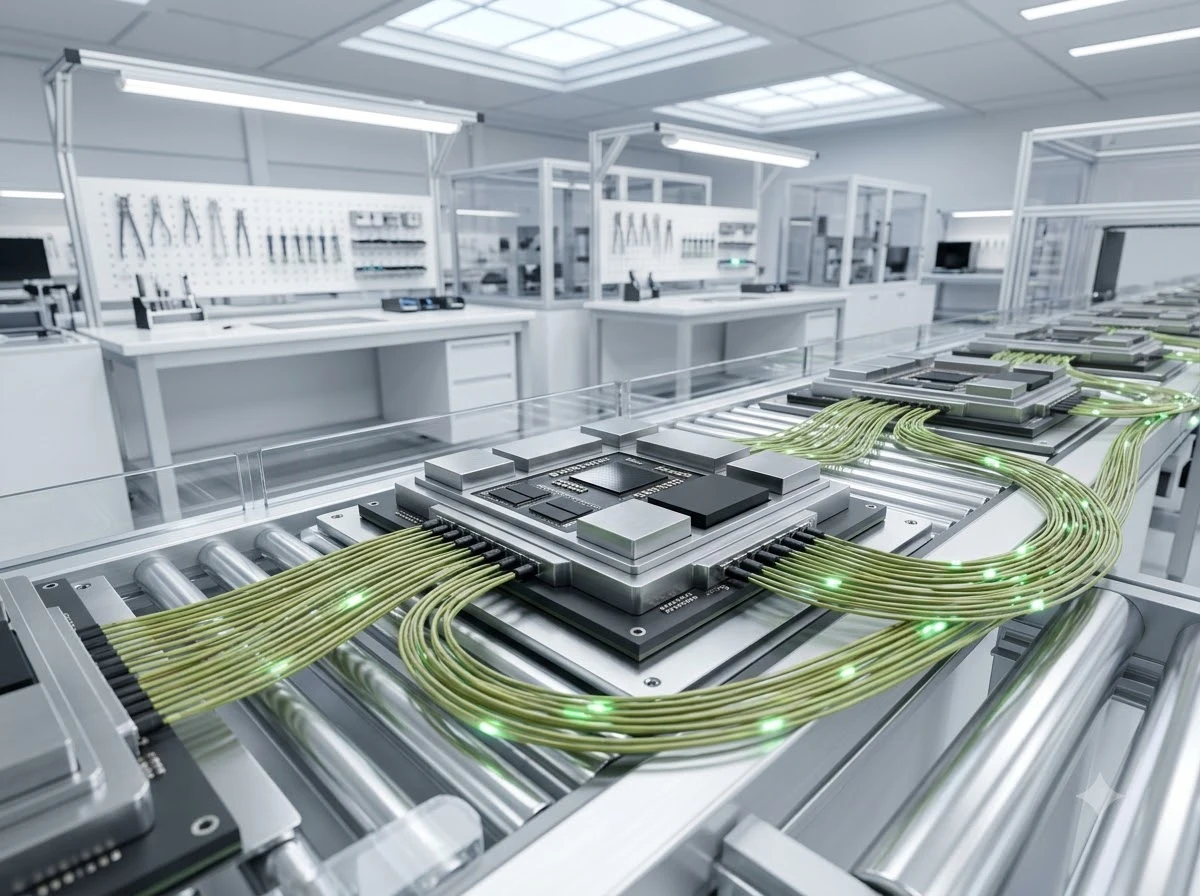
The company treats a data center as a factory whose product is the token. Instead of running every inference stage on the same general-purpose chip, Olix unrolls models across specialised silicon linked by optical interconnects.
That factory framing is more than branding. It drives chip layout, compiler design, interconnect choice and the hiring plan funded by the new capital. Every major decision in the Series B story traces back to the same production-line logic.
A $3.3 Billion Round With Arm and Hastings
Olix announced the financing on 3 August 2026. New money came from Fundomo, Arm and Hudson River Trading, plus angel Reed Hastings, co-founder of Netflix. Existing backers Hummingbird Ventures, Crane, Plural, Creandum, Phoenix Court and Transition all increased their stakes.
The UK government’s Sovereign AI venture fund also participated, its fifth equity investment since launch. Valuation more than tripled from just over $1 billion after a $220 million round in February.
| Metric | Detail |
|---|---|
| Series B amount | $312 million |
| Post-money valuation | $3.3 billion |
| Prior valuation (Feb 2026) | Just over $1 billion |
| Lead new investors | Fundomo, Arm, Hudson River Trading |
| Notable angel | Reed Hastings |
| CFO appointed | Matt Briers (ex-Wise) |
Matt Briers joined as chief financial officer. He spent nine years as CFO of Wise, taking the fintech from roughly 500,000 customers and losses through its 2021 London direct listing that valued the company at about $12 billion while it stayed profitable.
The investor mix is deliberate. Arm brings chip-design depth. Hudson River Trading brings latency-sensitive infrastructure experience. Hastings adds consumer-scale product instinct. Sovereign AI adds a policy mandate to keep the company headquartered and scaling in Britain. Together they cover industrial, financial and political bases before the first rack ships.
Briers’s appointment points the same way. A CFO who has already steered a London tech firm through a public listing is a signal that the company is building finance and governance muscle while the silicon is still in design.
Models Unrolled Across Specialist Silicon
Olix argues the industry’s general-purpose approach has hit efficiency limits. Producing one token requires hundreds of operations with different hardware demands. A conventional factory would assign purpose-built machines to each stage. AI data centers still force every stage onto the same chip.
The X-1 platform fully unrolls models across many chips so each focuses on one part of the model. Chips keep a flexible compute fabric rather than hard-coding any single architecture. The company describes the system as a token factory for frontier AI.
- Specialised chips handle distinct stages of token production
- Models spread across a production-line topology at rack scale
- Deterministic compiler schedules workloads across racks
- Flexible fabric adapts as model architectures evolve
This is the core disruption claim: stage-specific silicon can deliver a step change in performance and cost that successive generations of better generalists cannot match.
The flexible fabric matters because model architectures keep shifting. Hard-coded stage machines would risk obsolescence. A fabric that stays programmable lets the same silicon follow the models rather than force the models to follow the silicon. The deterministic compiler then becomes the scheduler on the factory floor, placing each workload where the hardware is strongest.
| Approach | How work is assigned | Hardware stance |
|---|---|---|
| General-purpose AI chips | Every inference stage on the same chip | One flexible device does all jobs |
| Olix X-1 platform | Model unrolled across many specialist chips | Stage-focused silicon plus flexible fabric |
Why Decode Gets Its Own Accelerator
The first chip inside X-1 is DX-1, a decode accelerator for the stage where a model reasons and generates output. For 100-billion-parameter models the company claims DX-1 delivers simultaneously over 10,000 tokens per second per user at higher output-token throughput per watt than general-purpose chips running large batches.
The architecture is designed to scale to models of 10 trillion parameters and beyond via multi-rack scale-up. DX-1 holds the model in fast on-chip SRAM. It uses no advanced packaging and no high-bandwidth memory, the components currently in shortest supply.
- 10,000+ tokens/sec/user claimed on 100B models
- Higher tokens per watt than large-batch general-purpose chips
- SRAM only, no HBM or advanced packaging
- Optical “slow and wide” interconnect using light instead of copper
The novel interconnect moves data directly between chips at ultra-low latency and energy cost through rack-scale co-design. Slow-and-wide designs favour many reliable lower-speed channels over a few ultra-fast ones, reducing the need for heavy error-correction silicon. Olix says this combination of specialised chips for each stage of the token production process will make frontier AI more affordable and unlock more powerful models.
Decode is a natural first target. It is the stage users feel as latency and the stage that burns energy when batches stay small. By isolating decode on DX-1, Olix can chase per-user speed and tokens per watt at the same time, rather than trading one for the other on a general-purpose die. Holding weights in on-chip SRAM removes a trip to external memory on every step, which is where much of the power and delay usually go.
Skipping HBM and advanced packaging is also a supply-chain bet. Those parts are scarce and expensive. A design that does not need them can plan volume without waiting in the same queues as the rest of the industry.
The Networking Veteran Who Joined the Board
Alongside the round Olix appointed Professor Nick McKeown to its board. McKeown co-invented software-defined networking, OpenFlow and P4. He is Professor Emeritus of Computer Science and Electrical Engineering at Stanford and the 2025 Marconi Society Prize Recipient.
He co-founded Nicira (acquired by VMware) and Barefoot Networks (acquired by Intel), later leading Intel’s networking business. On X, observers called the appointment the real signal: McKeown “wrote the networking playbook half this industry runs on.” His presence aligns directly with the optical scale-up and compiler challenges Olix faces.
The future of AI will be built on chips that power models. Countries that build chips will build leverage.
UK AI Minister Kanishka Narayan said that in the government release. He added that Olix is exactly the kind of ambitious company Sovereign AI wants to back, having established itself in two years as one of the UK’s most exciting AI startups with breakthrough chip technology.
Optical rack-scale links and a deterministic multi-rack compiler are networking problems as much as chip problems. McKeown’s career has been about making large numbers of devices behave as one programmable system. That is the exact gap between a promising decode die and a working token factory. His board seat ties the Series B story to the hardest systems work still ahead.
Sovereign AI Puts State Capital Behind the Chips
The government’s participation is more than a cheque. Sovereign AI invests in UK startup reinventing AI chips as its fifth equity deal, part of a wider programme that has now backed 11 startups with equity or compute access. The fund aims to keep high-potential AI companies headquartered and scaling in Britain.
Narayan framed chips as national leverage. Officials project the global AI chips market could reach one trillion dollars in the early 2030s; a 5 percent UK share would mean roughly $50 billion in revenue and tens of thousands of high-skilled jobs. Olix’s avoidance of HBM and advanced packaging shortages also reduces exposure to the same bottlenecks that drive up costs for many AI deployments, including the way UK’s AI storage costs keep draining budgets even after fee pledges.
The state bet sits alongside pure commercial capital from Arm, a major chip designer, and trading firm Hudson River Trading, which understands latency-sensitive infrastructure. That mix gives Olix both industrial and financial muscle.
For a pre-revenue hardware company, state capital also buys time. Tape-out, manufacturing commitments and rack integration stretch well beyond a typical software raise. A fund charged with keeping firms in Britain has an incentive to stay patient through that cycle, provided the technical milestones hold.
From CoMind to Olix in Two Years
Founder James Dacombe is 25. He previously founded brain-monitoring startup CoMind in 2018 and is a Thiel Fellow. Olix began life as Flux Computing in March 2024 before rebranding. The company now has more than 140 employees across London, Bristol, Austin, Toronto and San Francisco.
- 2018, Dacombe founds CoMind
- March 2024, Flux Computing registered; later becomes Olix
- February 2026, $220 million raise, valuation just over $1 billion
- August 2026, $312 million Series B at $3.3 billion; McKeown and Briers join
- H2 2027, Target first customer access for DX-1 systems
On X the valuation jump and Dacombe’s age fuelled claims he had become Europe’s youngest self-made billionaire on a large ownership stake. Those stake percentages remain unconfirmed by the company; the verified fact is the speed of the triple in six months and the pre-revenue status of the hardware.
Crowd reaction mixed pure excitement for UK hard tech with the obvious caveat that shipping and real-world tokens-per-watt still lie ahead. The appointment of a CFO who has already taken a London tech company public signals preparation for scale beyond the lab.
Five cities and more than 140 people in roughly two years is a fast build for silicon, photonics and compilers at once. The headcount spread across London, Bristol, Austin, Toronto and San Francisco matches the skill mix the roadmap needs: design talent in the UK, systems and go-to-market reach in North America.
Optical Links Carry the Factory Floor
The production-line model only works if chips can pass work to each other without burning the gains on the wire. Olix’s answer is an optical interconnect described as slow and wide: many reliable lower-speed light channels instead of a few ultra-fast copper paths.
That choice cuts the need for heavy error-correction silicon and keeps energy per bit low across the rack. Data moves directly between chips at ultra-low latency because the rack is co-designed with the links, not assembled from generic parts after the fact.
- Light replaces copper for chip-to-chip moves inside the rack
- Many lower-speed channels favoured over a few extreme ones
- Less error-correction logic on the die
- Rack-scale co-design keeps latency and energy in check
McKeown’s arrival underlines how central this layer is. Scale-up across racks, and eventually to multi-rack systems aimed at 10-trillion-parameter models, depends on the interconnect and the compiler agreeing on every transfer. The optical fabric is the conveyor belt in the token factory. If it stalls, specialist decode silicon cannot feed the next stage fast enough to matter.
Specialisation Sets Olix Apart From Rivals
Competitors are raising too, and the field is not empty. UK peer Fractile took $220 million earlier in 2026. US names such as Etched and SambaNova sit at far higher valuations. Capital alone will not decide the outcome.
Olix’s stated edge is the pairing of stage-specific silicon with optical scale-up that avoids HBM and advanced packaging. Rivals still tied to those scarce parts inherit the same cost and lead-time pressure that already shapes large deployments. A design that holds the model in SRAM and links chips with slow-and-wide optics is a bet that the constraint set itself can be changed.
| Company | Notable check or standing | Olix contrast drawn in the story |
|---|---|---|
| Fractile (UK) | $220 million raise earlier in 2026 | Same home market; different specialisation path |
| Etched, SambaNova (US) | Far higher valuations | Olix leaner on capital; claims a distinct topology |
| Olix | $312 million Series B at $3.3 billion | Production-line chips plus optical interconnect; no HBM |
None of that is proven in customer racks yet. The differentiator is still a claim until tokens per watt show up in the second half of 2027. What the round does is fund the attempt at full system depth: decode first, then the wider custom silicon platform, then manufacturing lock-in at frontier volumes.
Racks Target Second Half of 2027
Proceeds complete DX-1, expand the wider custom silicon platform, and lock manufacturing and supply-chain commitments needed for frontier inference volumes. Tape-out is expected later in 2026. Olix is hiring across silicon, photonics, compiler and systems engineering in its five cities.
Competitors are also raising. UK peer Fractile took $220 million earlier in 2026. US names such as Etched and SambaNova sit at far higher valuations. Olix’s differentiator remains the production-line specialisation plus optical interconnect that sidesteps the HBM and packaging constraints binding many rivals.
UK AI policy itself is under active scrutiny, from compute access to safety testing where AI agents social-engineered real maintainers in UK safety tests. Hardware that lowers inference cost and energy use feeds directly into those national goals.
If DX-1 delivers the claimed Pareto-optimal performance once racks reach customers, the general-purpose moat that has defined AI infrastructure for years will have a visible crack. The money, the board, and the state capital are now committed to finding out.


South Korea Retail Investors Face Reckoning After KOSPI AI Rally Collapses

Surrey AI Maps Three Heart Attack Paths and Their Molecular Roots

Germany Locks Neutral Apple ATT Prompts Across Most of Europe

Apple’s 5% EU Fee Quietly Rewrites Alternative App Store Math

Apple’s EU Fee Truce Cuts Complexity but Leaves Rivals Fuming

Pixel 11 Pro Fold Trades Thinness for Durability and Seven-Year Stay

Mayo AI Flags HCM Obstruction From Everyday Ultrasound Videos

Indian Brands Quietly Scale Landmark Screens and Home Tech

Navin Vatsa Turns Grief Into a Lifetime of Quiet Seeing

Google Bets Pixel 11 Agentic AI Will Redefine Phones

Oracle Cuts 21,000 Jobs in a Year, Cites AI in 10-K Filing

Fable 5 and Mythos 5 Return as US Lifts Anthropic Export Controls

SpaceX’s Google Deal Turns a Rocket Company Into a Cloud Landlord

CD Projekt Red Co-CEO: Redemption Arc Isn’t Done, Witcher 4 in 2027

XPL Rallies 30% Ahead of Plasma One Card Tier Launch

Google Search Profiles Build a Follow Graph Inside Discover

DGO App Brings Rs 549 Mobile Pass for FIFA World Cup 2026 in Nepal

Moonshot AI Targets $30 Billion in China’s Fastest AI Funding Sprint

Oppo’s ColorOS 17 Eligibility List Leaves A-Series Buyers Behind

Microsoft Xbox Layoffs Start in July as Sharma Slams 3% Margin
-
 AI2 months ago
Oracle Cuts 21,000 Jobs in a Year, Cites AI in 10-K Filing
-
 AI2 months ago
Fable 5 and Mythos 5 Return as US Lifts Anthropic Export Controls
-
 AI3 months ago
SpaceX’s Google Deal Turns a Rocket Company Into a Cloud Landlord
-
 GAMING2 months ago
CD Projekt Red Co-CEO: Redemption Arc Isn’t Done, Witcher 4 in 2027
-
 CRYPTO3 months ago
XPL Rallies 30% Ahead of Plasma One Card Tier Launch
-
 NEWS3 months ago
Google Search Profiles Build a Follow Graph Inside Discover
-
 APPS3 months ago
DGO App Brings Rs 549 Mobile Pass for FIFA World Cup 2026 in Nepal
-
 AI3 months ago
Moonshot AI Targets $30 Billion in China’s Fastest AI Funding Sprint