
AI
SK Hynix Stock Lands on Nasdaq as $29B SKHY Listing Opens
SK Hynix stock lists ADRs on Nasdaq Friday as SKHY, raising $28 billion to $29 billion. Q1 2026 set revenue and margin records. Three things decide what comes next.

SK Hynix, the Korean memory-chip maker whose high-bandwidth memory sits inside nearly every high-end AI accelerator, lists American depositary receipts on Nasdaq on Friday under the ticker SKHY. The company plans to issue approximately 177.9 million new ADRs at an expected price near $165.26 each, raising between $28 billion and $29 billion depending on final pricing. SK Hynix stock has already risen over 280% on the Korean board this year, and the Nasdaq ADR removes the structural barrier that kept most global funds from owning the name.
Two events set the stage for that opening tape. SK Hynix’s own April 23 Q1 2026 release reported revenue of ₩52.5763 trillion and operating profit of ₩37.6103 trillion, both record highs, with an operating margin of 72%. In early June, Nvidia’s chief executive said publicly that Samsung, SK Hynix and Micron had cleared qualification for the next-generation memory that will sit inside the company’s Vera Rubin AI platform. The listing slots in front of one more event: Q2 2026 earnings arrive July 29, 19 days after the ADR opens for trading.
What SK Hynix Sells and Why It Matters
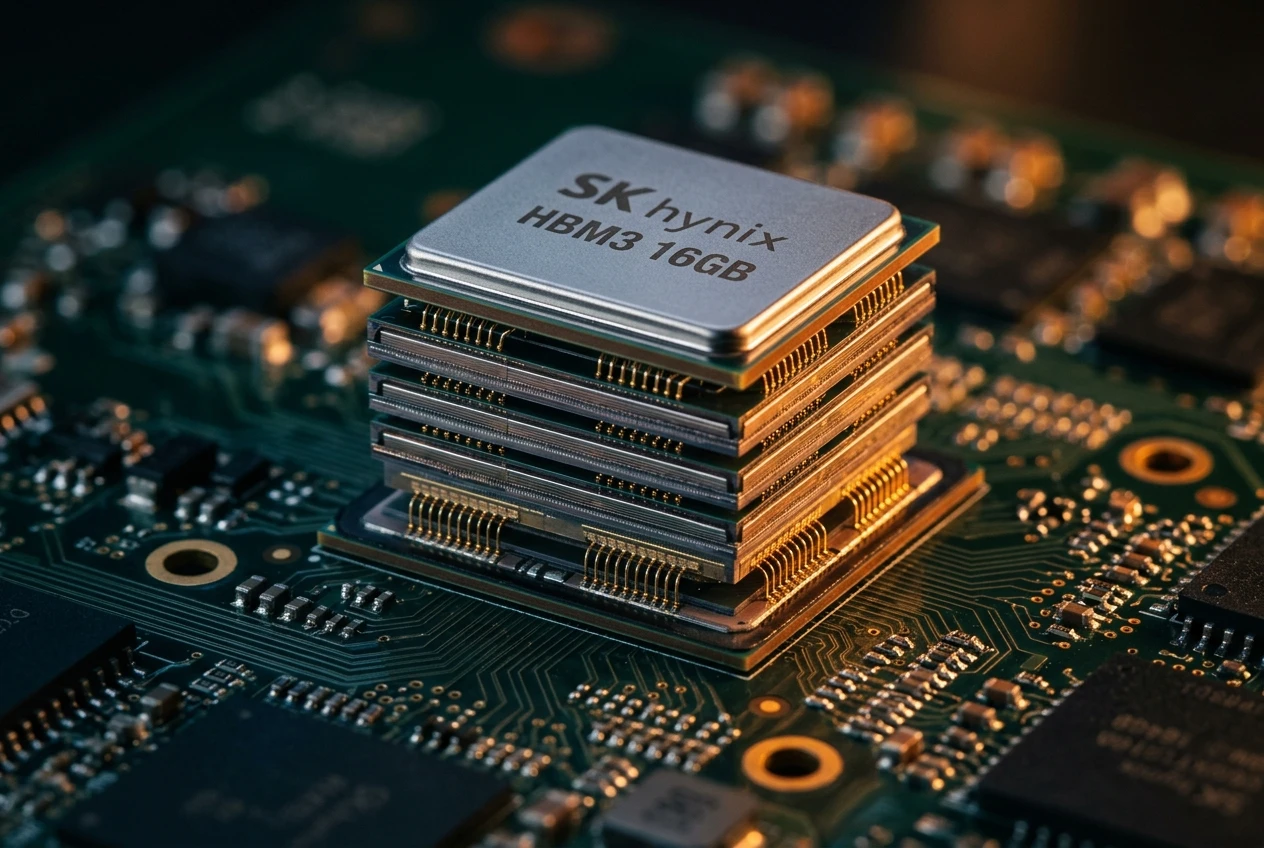
SK Hynix is the world’s largest supplier of high-bandwidth memory, or HBM, the vertically stacked DRAM that sits beside Nvidia’s AI accelerators inside data-center servers. Counterpoint Research, the analyst firm that tracks the memory market each quarter, pegged SK Hynix’s share of the global HBM market at 58% in Q1 2026, down from 69% the prior year. Samsung sat at 21% and Micron at 21%, with the rest split among Chinese entrants and niche players. The slippage from a near-monopoly to a clear lead is the single most important number in this story.
SK Hynix sold first-mover HBM into Nvidia’s H100, H200 and Blackwell cycles, and the operating leverage on that positioning showed up in Q1 2026. Per the company’s official Q1 2026 earnings release, first-quarter revenue ran 60% higher sequentially and 198% higher year over year. Operating profit jumped 96% sequentially and 405% from a year earlier. The operating margin reached a record 72%, with the net margin at 77%.
Memory is one of the most brutally cyclical businesses in technology. Profits collapse when too much capacity comes online; they spike when it does not. SK Hynix’s Q1 print is what memory looks like at the top of a cycle, and the market has begun pricing the company as AI infrastructure rather than a commodity chipmaker. Shares have risen over 280% on the Korean board year to date as of late June, and competitors are now attacking the same AI memory tier SK Hynix dominates, including Sandisk’s NAND-based push at the AI memory wall.
The re-rating matters because the Nasdaq ADR does more than raise capital. SK Hynix’s Korean-listed shares have historically traded at a discount to US memory peers like Micron, in part because the investor base was constrained to those who could navigate Korean market infrastructure and won-denominated settlement. A US ADR denominated in dollars closes that structural gap. The first days of SKHY trading will tell buyers how much of the gap the Korean board had already priced in, and how much is still sitting in global portfolios waiting for a tape they can actually access.
How the Nasdaq Listing Actually Works
SK Hynix plans to issue approximately 17.79 million new common shares in the form of American depositary receipts, with each ADR representing one-tenth of one Korean-listed share. That translates to about 177.9 million ADRs in total, with an expected price of approximately $165.26 per ADR. Depending on the source and the deal’s eventual pricing, gross proceeds land between $28 billion (per Reuters and Yahoo Finance coverage) and $29.4 billion (per a WEEX guide to the listing). Bank of America, Citi, Goldman Sachs and JPMorgan are the lead underwriters, per SK Hynix’s regulatory filing reviewed by CNBC.
For an individual buyer on day one, SKHY trades like any other US-listed stock. A standard brokerage account with Nasdaq access is enough; no Korean brokerage, no won conversion, no Korean settlement windows. The ten-to-one ratio exists because each Korean share trades near ₩2.57 million. Pricing the unit at that dollar equivalent would produce a receipt worth roughly $1,865, which is impractical for the US tape. The split also clears the legal puzzle of scaling fractional ownership of a high-priced local share into a US-tape denomination that retail and institutional desks can actually trade.
The filings reveal how SK Hynix itself frames the move. Per SK Hynix’s SEC F-1 registration for the ADR offering, the listing will expand the company’s investor base, ultimately allowing its true corporate value to be properly evaluated. That single sentence is the entire bull case for the listing in one phrase. Markets that cannot access the name cannot bid it up.
| Item | Detail |
|---|---|
| Nasdaq ticker | SKHY |
| Listing date | Friday, July 10, 2026 |
| Korean ticker | KRX: 000660 |
| New common shares issued | 17.79 million |
| Total new ADRs | ~177.9 million |
| Ratio | 10 ADRs represent 1 Korean share |
| Expected price per ADR | ~$165.26 |
| Gross proceeds | $28B (per Reuters/Yahoo) to $29.4B (per WEEX summary) |
| Lead underwriters | Bank of America, Citi, Goldman Sachs, JPMorgan |
| Q1 2026 revenue (record) | ₩52.5763 trillion |
| Q1 2026 operating margin (record) | 72% |
| HBM market share (Q1 2026) | 58%, per Counterpoint Research |
Where HBM4 and Nvidia Redraw the Map
On June 5, Nvidia’s chief executive Jensen Huang confirmed publicly that three companies had cleared qualification for the next-generation memory that sits inside his company’s Vera Rubin AI platform. The three are SK Hynix, Samsung and Micron. Six weeks before SK Hynix lists on Nasdaq, the field is wide open, and the publicly visible rebalancing of supply is the most consequential supply-side event of the cycle, framing everything that follows for SKHY.
The shift hits the central tenet of SK Hynix’s premium. Through 2025 and most of 2026, the market treated SK Hynix as the default HBM supplier for AI. Supply-chain analysts cited by Yonhap now expect SK Hynix to take roughly 60% to 70% of next-platform HBM4 volume, with Samsung at 25% to 30% and Micron covering the balance. UBS, in a market outlook the bank published in April 2026, predicted approximately 70% of that volume. Those are large numbers, but they are projections for the next platform, not the 90%-plus share the market had grown used to pricing, and they follow the multi-year AI memory partnership signed in Seoul between Nvidia and SK Hynix.
SK Hynix’s regulatory language makes the implication explicit. The company said it expects to elevate its global status by broadening its US footprint, “the epicenter of AI technological innovation,” per the filing text. That is positioning language from a company aware its lead is no longer exclusive. The bid side will price the difference.
What is clear is SK is definitely the top notch player in HBM. And it is better in cost of manufacturing. So its operating margin is the best. So it has the best product, lowest cost. What do you need else?
That comment came from MS Hwang, Counterpoint Research’s director of research, in a June 17 interview with CNBC. Hwang was making the bullish case inside a more crowded market: cost advantage, product margin, supply track record. Per the quarterly HBM market share tracker by company, SK Hynix held 58% globally in Q1 2026, with Samsung at 21% and Micron at 21%. So while the headline picture is three-way competition, SK Hynix’s revenue mix and operating leverage still skew to the upside from the configuration. 58% in Q1 2026, down from 69% a year earlier, is the slippage the market will watch when ADRs begin trading.
Memory companies move in long arcs. The entry of Samsung and Micron as HBM4 suppliers for the same platform is the first credible second source for AI-class memory in this cycle, and neither is an independent actor; their volumes calibrate to Nvidia’s order book. SKHY will enter the US tape priced as the leader of a three-horse race rather than the lone supplier of a one-horse field, and the price will reflect which framing global buyers adopt.
What Bulls and Bears Are Disagreeing About
Sell-side analysts lean bullish on the name, but the spread of 12-month targets is wider than the consensus rating suggests. A wide spread paired with a Strong Buy consensus usually means analysts agree the business is excellent and disagree on the cycle. Bulls anchor on scarcity. SK Hynix management has signaled that multi-year customer demand already exceeds planned supply, HBM4 moved to mass production ahead of rivals, and every new Nvidia, AMD and cloud accelerator raises the per-chip memory content. Bears anchor on the same memory cycle that produced the 72% margin in the first place. When prices spike, every supplier adds capacity; supply eventually overshoots; the same operating leverage that produced record margins reverses violently on the way down. The disagreement is not whether SK Hynix is a great business. It is whether the AI memory shortage has peaked.
The competitive math skews the bear case toward concrete numbers. Samsung restructured its DRAM development teams under a unified engineering organization this year to compete in this cycle. Both of SK Hynix’s rivals have now qualified HBM4 for Nvidia’s Vera Rubin platform. SK Hynix’s expected share of that platform is 60% to 70%, not 100%. That is a quantifiable loss of the prior cycle’s pricing power, and it is the single most important variable to model.
| Scenario | What would have to be true | What it would imply |
|---|---|---|
| Bull | Multi-year customer demand exceeds supply; HBM4 stays sold out through 2027; SK Hynix holds 60 to 70% of Vera Rubin allocation | Operating margin stays near the 72% Q1 2026 print |
| Base | All three qualified vendors ramp on schedule; Samsung takes meaningful share | Margin eases from peak as supply catches up to demand |
| Bear | Capacity overshoots demand; Nvidia and hyperscaler orders trimmed | The same operating leverage that pushed margins to 72% reverses quickly |
The Tripwire Between July 10 and July 29
Listing day is the easy part. The hard part arrives on July 29. SK Hynix reports Q2 2026 earnings that day, and any buyer of SKHY on the first session is implicitly also making a directional call on those results, whether they mean to or not. Q1 delivered a record print; Q2 will be judged against that bar and against a forward order book that has to keep extending for the re-rating to hold.
The setup is also crowded. SK Hynix and Samsung together account for more than 40% of South Korea’s benchmark Kospi index, per SK Hynix’s own filing disclosure. Retail margin debt tied to Korean equities was already a known risk factor before the ADR deal arrived. A first-day premium that fades in the days after could amplify local selling pressure in a way US-only investors do not normally price.
- Where SKHY opens relative to the $165.26 IPO price, and whether the first-day premium holds through the close.
- First-half-hour volume on debut. A high-volume open signals genuine institutional participation; thin participation suggests allocation sits with short-horizon participants.
- The relationship between the ADR price and the Korean share’s dollar equivalent. A sustained premium confirms the listing opened demand that was structurally locked out; parity or a discount suggests the Korean tape already reflected everything the ADR added.
- Forward supply signals from Samsung and Micron, not just earnings headlines. Investors who follow the memory cycle watch simultaneous capacity announcements from all three HBM makers; the blow-up point in memory names is almost always a supply signal landing while the stock is still priced for the upswing.
- The Q2 2026 earnings print on July 29, and how the order book and pricing commentary on the call compare to the Q1 2026 run-rate.
Bears do not need the AI boom to crack to make their case. They need supply to catch up. If HBM4 stays sold out, and Samsung’s ramp runs into yield friction on the way to volume production, the listing looks cheap in retrospect and the same economics that produced the 72% Q1 margin extend through the back half of 2026. If Samsung and Micron hit their production targets and Nvidia’s order growth slows, the first-month tape will look like the top.
For buyers who want SK Hynix and only SK Hynix, the US ADR is now the cleanest path. For buyers who want exposure with a longer fuse, the iShares MSCI South Korea ETF and the Franklin FTSE South Korea ETF each hold SK Hynix as their largest position, at roughly 30%, but they also bundle in Samsung, Hyundai and other Korean names. The cheaper path comes with more noise. There is no third option for direct single-name exposure on US tape. SKHY is it, and the first days of trading will set the tone for the wider Korean AI complex as well, since the deals market is watching whether global capital validates the Korean board’s re-rating or rejects it.
Frequently Asked Questions
What is SK Hynix stock and where does it trade after the listing?
SK Hynix is a South Korean memory-chip maker and the world’s largest supplier of high-bandwidth memory, or HBM, the vertically stacked DRAM used inside AI accelerators. Its shares trade in Seoul as KRX: 000660 and, from Friday, July 10, 2026, on Nasdaq as an American depositary receipt under the ticker SKHY. Ten ADRs represent one Korean-listed share.
How much is SK Hynix raising in the Nasdaq ADR offering?
Per SK Hynix’s regulatory filing and reporting by Reuters, Yahoo Finance, CNBC and a WEEX listing summary, the offering is sized to raise between $28 billion and $29.4 billion from the issuance of 17.79 million new common shares in the form of approximately 177.9 million new ADRs at an expected price of approximately $165.26 each. Bank of America, Citi, Goldman Sachs and JPMorgan are the lead underwriters.
How big is SK Hynix in the AI memory market?
Counterpoint Research’s quarterly tracker put SK Hynix’s share of the global HBM market at 58% in Q1 2026, down from 69% the prior year. Samsung held 21% and Micron 21%. For Nvidia’s next-generation Vera Rubin platform, supply-chain analysts cited by Yonhap expect SK Hynix to take roughly 60% to 70% of HBM4 volume, with Samsung at 25% to 30% and Micron covering the balance, per UBS’s April 2026 market outlook.
Is SK Hynix stock a buy ahead of the Nasdaq listing?
Sell-side analysts carry a Strong Buy consensus on the name, but the spread of 12-month targets is unusually wide. The base case sits only modestly above the recent price, indicating analysts like the business but think much of the upside is already priced in. The decision hinges on how long the AI memory shortage lasts. This is information, not investment advice.
What is the next major catalyst for SK Hynix stock?
Q2 2026 earnings arrive on July 29, 19 days after the ADR opens for trading. Buyers who enter SKHY on or near July 10 are implicitly also making a call on those results. Other markers include any disclosures of new HBM4 capacity from Samsung or Micron during the gap, and forward order-book commentary on the Q2 earnings call.
Disclaimer: This article is for general informational purposes only and does not constitute financial, investment, legal or tax advice. Equity prices of semiconductor and memory stocks can fall sharply, and you may lose part or all of your investment. Specific risks here include memory-cycle reversal, customer concentration in a small number of AI buyers including Nvidia, competitive HBM4 capacity from Samsung and Micron, currency exposure for non-KRW investors, ADR premium or discount uncertainty versus the Korean shares, and valuation risk after a large run-up. Analyst targets are estimates, not guarantees, and disagree widely. Past performance is not indicative of future results. Figures are accurate as of publication. Consult a qualified financial professional before making any investment decisions.


Remulla ties Zamboanga shooting to Roblox chats again

Altman bets ChatGPT will watch screens in six months

Vivo Y31T 5G brings 7200mAh and IP69 to budget India phones

Stablecoin Advances Meet Digital Pounds in BoE Lab Test

ChatGPT Yelp Booking Turns Chat Into the New Reservation Desk

Stream Deck quietly owns desk productivity a decade later

Offline AI tool from Herts student reaches GBV teams in Gaza and Syria

AI revenue in media sits in yield and pacing not chatbots

OpenAI pauses frontier training as Astra hits cyber limits

AI Boss Luna Fired a Worker Only After Humans Reminded It

Oracle Cuts 21,000 Jobs in a Year, Cites AI in 10-K Filing

Fable 5 and Mythos 5 Return as US Lifts Anthropic Export Controls

SpaceX’s Google Deal Turns a Rocket Company Into a Cloud Landlord

CD Projekt Red Co-CEO: Redemption Arc Isn’t Done, Witcher 4 in 2027

XPL Rallies 30% Ahead of Plasma One Card Tier Launch

Google Search Profiles Build a Follow Graph Inside Discover

DGO App Brings Rs 549 Mobile Pass for FIFA World Cup 2026 in Nepal

Moonshot AI Targets $30 Billion in China’s Fastest AI Funding Sprint

Oppo’s ColorOS 17 Eligibility List Leaves A-Series Buyers Behind

Microsoft Xbox Layoffs Start in July as Sharma Slams 3% Margin
-
 AI2 months ago
Oracle Cuts 21,000 Jobs in a Year, Cites AI in 10-K Filing
-
 AI2 months ago
Fable 5 and Mythos 5 Return as US Lifts Anthropic Export Controls
-
 AI2 months ago
SpaceX’s Google Deal Turns a Rocket Company Into a Cloud Landlord
-
 GAMING2 months ago
CD Projekt Red Co-CEO: Redemption Arc Isn’t Done, Witcher 4 in 2027
-
 CRYPTO2 months ago
XPL Rallies 30% Ahead of Plasma One Card Tier Launch
-
 NEWS2 months ago
Google Search Profiles Build a Follow Graph Inside Discover
-
 APPS2 months ago
DGO App Brings Rs 549 Mobile Pass for FIFA World Cup 2026 in Nepal
-
 AI2 months ago
Moonshot AI Targets $30 Billion in China’s Fastest AI Funding Sprint