
AI
China’s Exports Jump 27% in June, Powered by Chips and AI Demand
China’s exports rose 27% in June, the fastest pace since 2021, as AI chip demand and a tariff deadline rush drove trade past every forecast.

China’s exports jumped 27% in June from a year earlier, the fastest pace since October 2021, as semiconductor and AI hardware shipments outran a wave of tariff anxiety. Imports climbed even faster, up 36%, pushing the trade surplus to $125.6 billion, customs data released Tuesday showed.
Both numbers blew past every estimate in a Reuters poll of 20 economists, who had penciled in 18.2% export growth and a $120.6 billion surplus. Strip out chips, AI hardware and vehicles, though, and most of what China actually sells the world barely moved at all.
China’s Best Export Month Since 2021
Exports totaled $412.39 billion in June, according to China’s customs agency, the General Administration of Customs, while imports reached $286.76 billion. That combination produced a trade surplus up from $105.4 billion in May.
Wang Jun, vice minister of the customs agency, credited the surge to Chinese manufacturers matching output to demand across a wide range of markets. “The fundamental reason for the growth in exports lies in the precise alignment between products made in China and diverse global demand,” he said.
| Metric | May 2026 | June 2026 (Actual) | Reuters Poll Forecast for June |
|---|---|---|---|
| Exports, year on year | 19.4% | 27% | 18.2% |
| Imports, year on year | 27.4% | 36% | 24% |
| Trade surplus | $105.4 billion | $125.6 billion | $120.6 billion |
The export engine has run hot most of this year. Back in January and February, shipments notched their biggest gain in four years, according to ING’s economics research desk, before momentum cooled in spring and then snapped back in June.
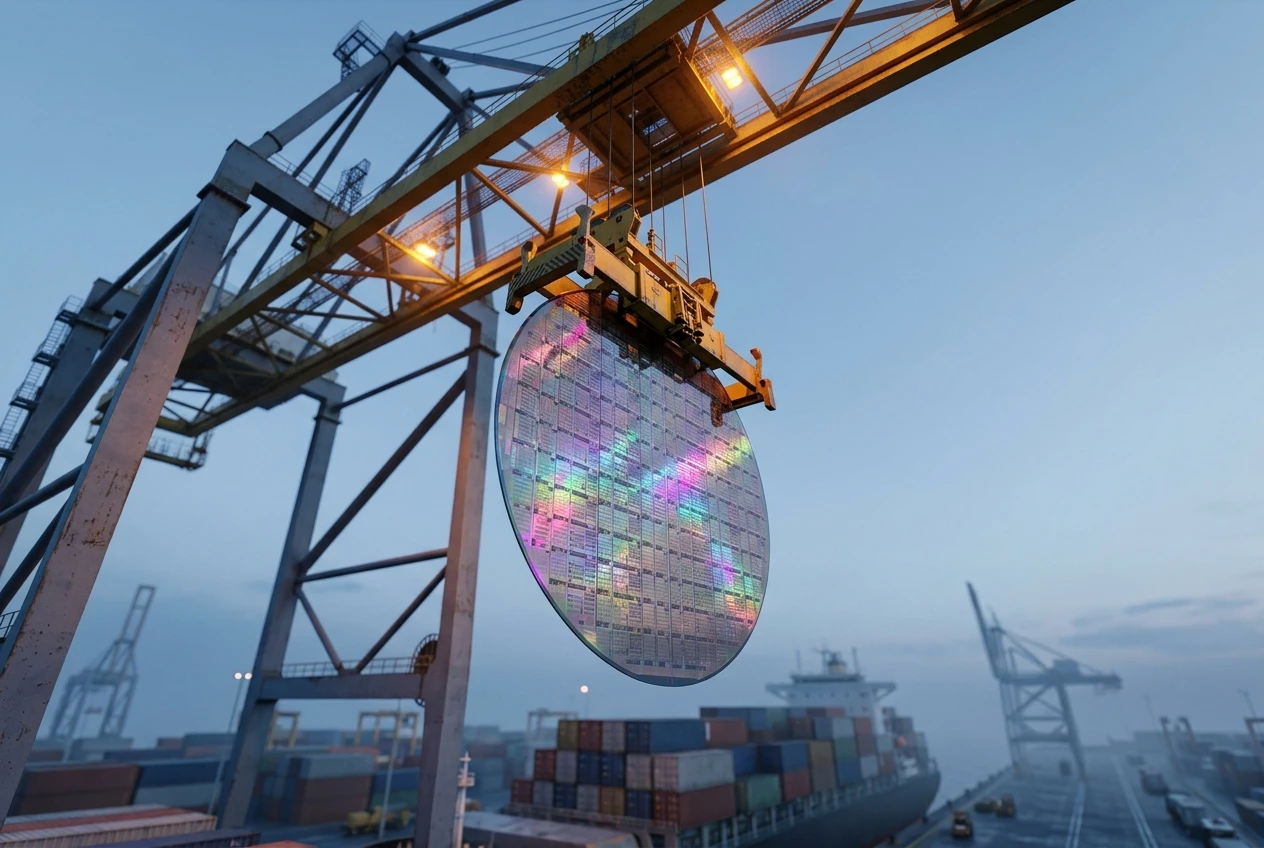
Why Is AI Hardware Carrying China’s Trade Engine?
Global data centre buildouts need chips, memory and computing hardware faster than suppliers can produce them, and Chinese factories are filling a growing share of that order book. Imports of foreign-made semiconductors jumped, vehicle exports kept climbing, and the resulting demand is now doing more to hold up China’s economy than anything happening at home.
Imports from South Korea, a major supplier of memory chips, rose 85% in June from a year earlier. Purchases from Taiwan, another top semiconductor source, climbed 41.1% over the same period. Vehicle exports, especially EVs, rode the same wave, as rising AI adoption pulls through demand for semiconductors and other electronic equipment, the Associated Press reported.
The squeeze is visible well beyond China’s ports. Samsung’s own memory chip unit has been cushioning its smartphone price hikes from the same shortage rippling through consumer electronics. Nvidia, still the world’s most valuable company, has watched its own stock trail the broader chip rally even as orders for its hardware pile up.
Beijing is happy to ship the hardware abroad. It has been far more guarded about the software running on it, having moved to wall off its top AI models from the world even as demand for the chips underneath them keeps climbing.
Continued export strength, mostly driven by AI, points to a better second half, coupled with a more expansionary policy mix, accelerated fiscal spending and mild monetary easing, as well as a de-escalation of the situation in the Middle East, which will benefit China through lower oil prices.
Xu Tianchen, a senior economist at the Economist Intelligence Unit in Beijing, said the picture at home looks a lot less encouraging. “Retail sales remain pretty flat and fixed asset investment was negative last month,” he said.
A 60% Surge Next to a 2% Crawl
May’s trade breakdown, the most detailed available by product category, shows how lopsided the boom really is. Automated data processing equipment, the customs category covering servers and computing hardware, jumped in value terms from a year earlier. Furniture barely grew at all.
| Export Category | Year-on-Year Growth (May 2026) |
|---|---|
| Automated data processing equipment | 60% |
| Semiconductor shipments | 110% |
| Furniture | 1.9% |
Semiconductor shipments alone surged 110% that month, Semafor reported, even as domestic car sales were falling 22% from a year earlier, marking a sixth straight month of double-digit declines.
“While growth is likely to continue, it is increasingly fragile,” said Wei Li, head of multi-asset investments at BNP Paribas Securities (China).
Regulators have their own reasons to worry about the mix. China’s market watchdog has renewed a crackdown on so-called “involution-style” competition, the price wars that have squeezed corporate margins in electric vehicles, solar panels, batteries, steel and even food delivery.
Racing the Tariff Clock
Part of June’s surge was simple timing. U.S. retailers moved orders forward by four to six weeks to stock shelves for Black Friday and Christmas ahead of an expected round of tariff increases, pulling future demand into the present.
President Donald Trump’s May visit to Beijing failed to produce the breakthrough both sides had hoped for, leaving the trade relationship no clearer than before. A 10% broad-based duty on goods from most trading partners is set to expire on July 24, and manufacturers are bracing for whatever follows from Washington’s Section 301 investigations.
Washington has already signaled part of the answer. Separate semiconductor-specific duties on Chinese chip imports are not due to take effect until 2027, giving the current chip rush more runway than the broader tariff truce.
The growth also skewed sharply by destination.
- Southeast Asia: exports up 35%, imports from the region up 27%.
- European Union: exports up 18.5%, imports from the bloc up more than 9%.
- United States: exports up 14%, imports of American goods up 26%, per CNBC’s calculations of the official data.
Beijing’s own policymakers are watching the calendar too. A Politburo meeting expected in late July will offer the next real signal on stimulus, though analysts think leaders will hold off unless growth slows more sharply, given how resilient exports have been.
Even the Bulls Missed This One
Ahead of Tuesday’s release, forecasters were split on how strong June would be. Nobody landed close.
- BNP Paribas and Mizuho Securities both forecast 20% export growth, the most bullish calls in the Reuters poll.
- China Industrial Securities and Shanghai Securities came in far more cautious, at just 12%, the lowest readings in the poll.
- The actual print came in at 27%, seven points above even the bulls.
Goldman Sachs Research had been leaning bullish too, projecting roughly 8% growth in China’s real exports for the full year and lifting its GDP forecasts above consensus. June’s dollar-value number still cleared that bar with room to spare.
What China’s GDP Report Still Has to Show
China releases second-quarter GDP on Wednesday, alongside industrial output and retail sales for June. Economists polled by Reuters expect growth to have cooled to 4.5%, down from 5% in the first quarter, still inside Beijing’s target range of 4.5% to 5% for the year.
Industrial output is projected to expand 4.7%. Retail sales are expected to shrink 0.1%. Urban investment is estimated to have declined 4.9% in the first half, a deeper drop than the 4.1% decline recorded through the first five months.
The pattern behind those numbers is now familiar. A global AI-fuelled export boom is lifting advanced manufacturing while household spending, private investment and the property market keep pulling the other way. China’s National Bureau of Statistics publishes the full breakdown Wednesday morning in Beijing.


South Korea Retail Investors Face Reckoning After KOSPI AI Rally Collapses

Surrey AI Maps Three Heart Attack Paths and Their Molecular Roots

Germany Locks Neutral Apple ATT Prompts Across Most of Europe

Apple’s 5% EU Fee Quietly Rewrites Alternative App Store Math

Apple’s EU Fee Truce Cuts Complexity but Leaves Rivals Fuming

Pixel 11 Pro Fold Trades Thinness for Durability and Seven-Year Stay

Mayo AI Flags HCM Obstruction From Everyday Ultrasound Videos

Indian Brands Quietly Scale Landmark Screens and Home Tech

Navin Vatsa Turns Grief Into a Lifetime of Quiet Seeing

Google Bets Pixel 11 Agentic AI Will Redefine Phones

Oracle Cuts 21,000 Jobs in a Year, Cites AI in 10-K Filing

Fable 5 and Mythos 5 Return as US Lifts Anthropic Export Controls

SpaceX’s Google Deal Turns a Rocket Company Into a Cloud Landlord

CD Projekt Red Co-CEO: Redemption Arc Isn’t Done, Witcher 4 in 2027

XPL Rallies 30% Ahead of Plasma One Card Tier Launch

Google Search Profiles Build a Follow Graph Inside Discover

DGO App Brings Rs 549 Mobile Pass for FIFA World Cup 2026 in Nepal

Moonshot AI Targets $30 Billion in China’s Fastest AI Funding Sprint

Oppo’s ColorOS 17 Eligibility List Leaves A-Series Buyers Behind

Microsoft Xbox Layoffs Start in July as Sharma Slams 3% Margin
-
 AI2 months ago
Oracle Cuts 21,000 Jobs in a Year, Cites AI in 10-K Filing
-
 AI2 months ago
Fable 5 and Mythos 5 Return as US Lifts Anthropic Export Controls
-
 AI3 months ago
SpaceX’s Google Deal Turns a Rocket Company Into a Cloud Landlord
-
 GAMING2 months ago
CD Projekt Red Co-CEO: Redemption Arc Isn’t Done, Witcher 4 in 2027
-
 CRYPTO3 months ago
XPL Rallies 30% Ahead of Plasma One Card Tier Launch
-
 NEWS3 months ago
Google Search Profiles Build a Follow Graph Inside Discover
-
 APPS3 months ago
DGO App Brings Rs 549 Mobile Pass for FIFA World Cup 2026 in Nepal
-
 AI3 months ago
Moonshot AI Targets $30 Billion in China’s Fastest AI Funding Sprint