
AI
Nvidia’s Vera CPU Push Quietly Hands Arm Holdings a Win
Nvidia’s Vera CPU opens a $200 billion market beyond GPUs, and Arm Holdings collects royalties on every chip Nvidia ships regardless of who wins.

Nvidia’s newest chip could ship four million to five million units before the end of 2026, according to Bank of America, more than the company has shipped of its previous data-center CPU in its entire history combined. Every one of those new chips still owes a toll to a company most AI investors never trade directly.
That company is Arm Holdings, and its fingerprints are on the instruction set running inside Nvidia’s (NVDA) new Vera processor. Wall Street has spent weeks framing Vera as the vehicle for Nvidia’s next act beyond graphics chips. Wedbush Securities says the processor could expand Nvidia’s total addressable market by billions of dollars. Nvidia’s own numbers are even bigger, and the ripple effects reach further down the supply chain than most of that coverage has said out loud.
Vera Is Nvidia’s Biggest Bet Beyond the GPU
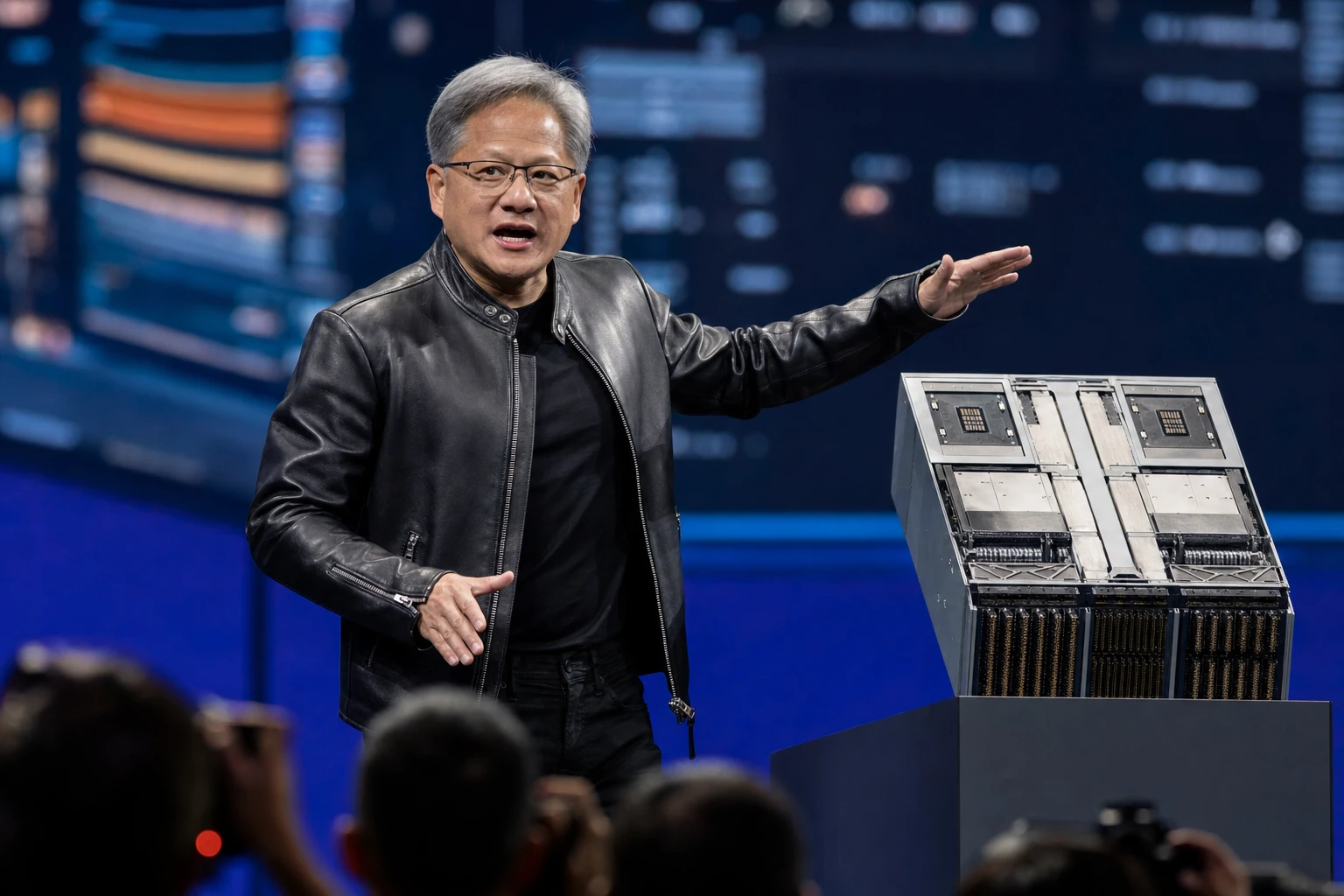
Vera is Nvidia’s first server processor built mostly from its own designs rather than licensed parts. CEO Jensen Huang introduced it this spring and reiterated the stakes on Nvidia’s fiscal 2027 first-quarter earnings call in May, telling investors “Vera opens a brand new $200 billion TAM for Nvidia, a market we have never addressed before.”
That is a specific, enormous number for a company that only ever competed in graphics accelerators. The chip carries 88 of Nvidia’s own “Olympus” cores, a departure from the licensed Arm Neoverse V2 cores inside Nvidia’s earlier Grace CPU, and supports up to 176 threads through a spatial multithreading design. Vera is built to feed data to Nvidia’s Rubin GPUs fast enough that the expensive silicon never sits idle waiting on the processor.
Vera does not ship alone. It anchors an entire rack-scale system Nvidia calls Vera Rubin, and the components read like a full computing stack rather than a single chip upgrade:
- An 88-core Vera CPU handling orchestration, data prep and agent workflows
- A Rubin GPU carrying 288 GB of HBM4 memory for AI training and inference
- A Rubin CPX GPU with 128 GB of GDDR7 for specialized workloads
- NVLink 6.0 switch silicon for rack-scale GPU-to-GPU connectivity
- A BlueField-4 data processing unit with integrated storage for key-value caching
- Spectrum and Quantum photonics networking for scaling across racks
A single Vera Rubin NVL72 rack packs 3,168 of Nvidia’s custom Olympus cores, 22% more than the Grace-based rack it replaces, according to CoreWeave’s own infrastructure specifications. Nvidia says commercial shipments to system builders and cloud partners begin in the third quarter of 2026.
Nvidia’s Earnings Keep Outrunning Wall Street
The CPU bet lands on top of a business that is still accelerating, not cooling. Nvidia’s fiscal 2027 first-quarter revenue jumped 85% year over year to $81.6 billion, beating analyst expectations with room to spare. Data center revenue alone climbed 92% to $75.2 billion, the clearest sign that AI infrastructure spending has not slowed.
Net income surged 211% to $58.3 billion, and earnings per share reached $2.39. The company generated roughly $48.6 billion in free cash flow during the quarter and finished with about $13.2 billion in cash. Management guided to roughly $91 billion in second-quarter revenue, a figure that assumes zero China data-center sales because of export restrictions.
NVDA shares have not kept pace with that growth. The stock is up about 28% over the past year but only around 13% so far in 2026, weighed down by China policy risk, rising competition and profit-taking after last year’s rally. The gap between the fundamentals and the stock price is exactly why analysts keep pointing to Vera as an underpriced second act.
Arm Holdings Is Cashing In on Every Vera Chip Sold
Nvidia built Vera’s cores in-house, but the chip still runs on Arm’s v9.2 instruction set, and that license did not disappear when Nvidia stopped using Arm’s off-the-shelf Neoverse designs. Each Vera chip that ships still sends a royalty back to Arm, because Nvidia’s custom core remains built on Arm’s licensed architecture.
The market noticed immediately. Arm stock jumped 14% intraday the day Nvidia unveiled Vera and the companion RTX Spark Superchip in Taipei, a reaction few CPU announcements produce for a company that was not even the one launching a product. The numbers behind that reaction were already moving before the announcement:
- 14%: Arm’s intraday stock jump the day Nvidia showed off Vera and RTX Spark in Taipei
- $671 million: Arm’s fiscal fourth-quarter royalty revenue, up 11% year over year, with data-center royalties more than doubling
- $2 billion-plus: committed customer demand logged for Arm’s own competing data-center CPU across fiscal 2027 and 2028, double what the company disclosed at launch
- 250%: Arm shares’ year-to-date gain through early June 2026
Arm’s business model means it gets paid whether Nvidia wins, AMD wins, or a hyperscaler builds its own Arm-based chip in-house. As chipmakers keep designing specialized silicon for AI workloads, Arm’s architecture keeps showing up underneath the products getting all the headlines, without Arm ever having to sell a single server itself.
Who Loses When Nvidia Sells CPUs Too?
Intel and AMD absorb most of the downside. Intel’s share of x86 server CPU units has fallen to the lowest level the company has ever recorded, AMD is still gaining ground but now has to defend that gain against Nvidia too, and at least one hyperscaler is already running Nvidia CPUs with no Nvidia GPU attached at all.
That hyperscaler is Meta. The companies expanded a multiyear data-center agreement that includes millions of Nvidia’s Blackwell and Rubin GPUs, and, separately, Meta’s rollout of Grace CPU-only servers marks the first large-scale deployment of Nvidia processors running without any Nvidia graphics chip nearby. “Nvidia has been on the path of providing more of the content in the data center for a while,” analyst Gil Luria told Yahoo Finance.
The unit-share math shows why Intel and AMD are worried:
| Chipmaker | Server CPU Share | Direction | What’s Driving It |
|---|---|---|---|
| Intel | 72.2% of x86 server CPU units | Falling, the lowest share on record | Aging generation losing ground to newer rivals |
| AMD | 27.8% of x86 server CPU units | Rising, some estimates see 40%-plus by year end | New Zen 6 “Venice” chips just began shipping |
| Arm-based (including Nvidia Grace and Grace Blackwell) | 13.2% of total server CPU sales | Fastest-growing category | Grace Blackwell pairings drove 50% higher Arm server volume |
Intel, AMD and Nvidia together still control roughly 55% of the broader data center CPU market, according to a market analysis tracking vendor share trends. Smaller rivals are circling the same budgets from a different angle. In India, Turiyam is racing to build a cheaper AI inference chip aimed at exactly the workloads Nvidia wants Vera to capture.
The Valuation Case Still Holds Up
Despite the run since 2023, Nvidia does not trade like a stock priced for perfection. Shares change hands at roughly 23 times forward earnings, below the broader tech sector average even though Nvidia’s earnings are growing far faster than that average. Its PEG ratio sits at 0.45, a level that usually signals a stock is cheap relative to its own growth, not expensive.
Wall Street expects Nvidia to generate well over $300 billion in fiscal 2027 revenue, with consensus earnings estimates near $8.80 per share. The average analyst price target sits at $302.55, implying about 43% upside from current levels. If Vera adoption ramps the way Bank of America projects, those estimates have room to move higher rather than lower.
Racks like Vera Rubin’s do not run cheap or cool. They draw enormous power, part of why Wall Street pushed a record $11.6 billion into energy IPOs this year to keep pace with AI’s electricity appetite.
What Could Slow the Vera Rollout
China remains the biggest variable. Nvidia’s $91 billion guidance already assumes no China data-center revenue, and when Huang was asked directly in Taipei whether his $200 billion TAM figure includes China, he answered simply, “I would think so.” That is an admission the number carries real uncertainty baked in, not a settled fact.
Competition is not standing still either. AMD’s new Zen 6 “Venice” server chips began shipping the same week Vera coverage picked up, and Intel still controls the largest installed base of any x86 vendor even as its share erodes. Nvidia’s decision to design its own Olympus cores instead of licensing Arm’s stock designs also suggests a long-term push toward less outside dependency, even though the architecture license Arm still collects on today shows no sign of going away soon.
Vera ships to system builders and cloud customers starting in the third quarter of 2026, when Wall Street’s $200 billion bet starts collecting receipts.
Frequently Asked Questions
Can consumers buy an Nvidia Vera CPU?
No. Vera is an enterprise and cloud product sold through system builders and hyperscale partners starting in the third quarter of 2026. Nvidia has not disclosed retail pricing or a consumer version, and none is expected given the chip’s data-center design target.
How much does a Vera-based server rack cost?
A fully configured rack with 256 Vera chips runs around $10 million, according to Forbes contributor and semiconductor analyst Karl Freund, which implies an effective price near $30,000 to $40,000 per chip once memory and system costs are included.
What happens to Nvidia’s China business under export restrictions?
Nvidia’s guidance assumes zero China data-center compute revenue for the current quarter. Reporting on the restrictions has noted they have also opened room for domestic rival Huawei to capture an estimated $12 billion in business Nvidia can no longer pursue there.
Has Arm Holdings stock actually benefited from Nvidia’s chip news?
Yes. Arm shares gained more than 250% year to date through early June 2026, helped by Nvidia building both the Vera data-center chip and the RTX Spark Superchip on Arm’s architecture, though Arm’s overall royalty revenue remains far smaller in dollar terms than Nvidia’s data-center business.
Disclaimer: This article is for informational purposes only and does not constitute investment advice; stock prices, estimates and price targets change quickly, so consult a licensed financial advisor before trading, and figures here are accurate as of publication.


South Korea Retail Investors Face Reckoning After KOSPI AI Rally Collapses

Surrey AI Maps Three Heart Attack Paths and Their Molecular Roots

Germany Locks Neutral Apple ATT Prompts Across Most of Europe

Apple’s 5% EU Fee Quietly Rewrites Alternative App Store Math

Apple’s EU Fee Truce Cuts Complexity but Leaves Rivals Fuming

Pixel 11 Pro Fold Trades Thinness for Durability and Seven-Year Stay

Mayo AI Flags HCM Obstruction From Everyday Ultrasound Videos

Indian Brands Quietly Scale Landmark Screens and Home Tech

Navin Vatsa Turns Grief Into a Lifetime of Quiet Seeing

Google Bets Pixel 11 Agentic AI Will Redefine Phones

Oracle Cuts 21,000 Jobs in a Year, Cites AI in 10-K Filing

Fable 5 and Mythos 5 Return as US Lifts Anthropic Export Controls

SpaceX’s Google Deal Turns a Rocket Company Into a Cloud Landlord

CD Projekt Red Co-CEO: Redemption Arc Isn’t Done, Witcher 4 in 2027

XPL Rallies 30% Ahead of Plasma One Card Tier Launch

Google Search Profiles Build a Follow Graph Inside Discover

DGO App Brings Rs 549 Mobile Pass for FIFA World Cup 2026 in Nepal

Moonshot AI Targets $30 Billion in China’s Fastest AI Funding Sprint

Oppo’s ColorOS 17 Eligibility List Leaves A-Series Buyers Behind

Microsoft Xbox Layoffs Start in July as Sharma Slams 3% Margin
-
 AI2 months ago
Oracle Cuts 21,000 Jobs in a Year, Cites AI in 10-K Filing
-
 AI2 months ago
Fable 5 and Mythos 5 Return as US Lifts Anthropic Export Controls
-
 AI2 months ago
SpaceX’s Google Deal Turns a Rocket Company Into a Cloud Landlord
-
 GAMING2 months ago
CD Projekt Red Co-CEO: Redemption Arc Isn’t Done, Witcher 4 in 2027
-
 CRYPTO2 months ago
XPL Rallies 30% Ahead of Plasma One Card Tier Launch
-
 NEWS2 months ago
Google Search Profiles Build a Follow Graph Inside Discover
-
 APPS2 months ago
DGO App Brings Rs 549 Mobile Pass for FIFA World Cup 2026 in Nepal
-
 AI2 months ago
Moonshot AI Targets $30 Billion in China’s Fastest AI Funding Sprint