
CRYPTO
Tenev Called Memecoins Useless. One Just Surged on His Chain.
Robinhood CEO Vlad Tenev said RWAs are crypto’s future and meme coins aren’t productive. CASHCAT then surged on his own RWA-optimized chain.

Robinhood launched the Robinhood Chain on July 1 as a venue for tokenized U.S. stocks and bonds, then watched a cat-themed memecoin on that same network surge roughly 950% in twenty-four hours. CEO Vlad Tenev had spent the week before the surge telling CNBC that the future of crypto lies in real-world assets and that tokens without underlying utility are not productive. The chain he shipped one day earlier is now hosting one of those tokens, and the traffic has been hard to ignore.
The tension cuts both ways. Robinhood’s strategic case for the chain depends on attracting institutional partners and tokenized equity volume, the kind of flow the company pitched in its July 1 London keynote. A speculative memecoin on day one complicates that pitch, and the company’s purpose-built for real-world assets framing has to absorb a market that does not care about framing. At the same time, the chain is processing transactions, and a publicly traded brokerage whose shares trade on Nasdaq has reasons to welcome any volume that justifies the build.
The Chain That Launched for Real-World Assets
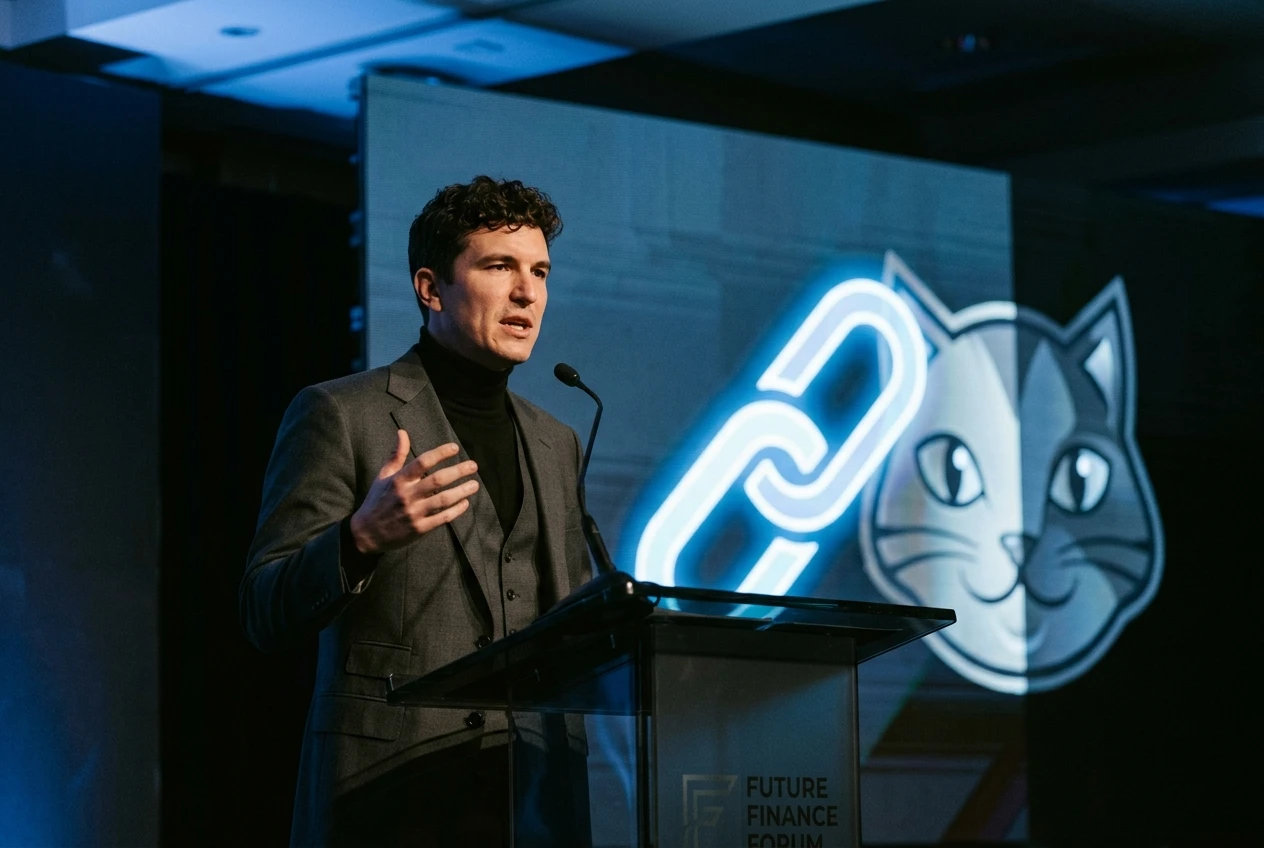
Robinhood put its blockchain ambitions into production on July 1, streaming a keynote called “The World is Flat” from the Old Royal Naval College in London. CEO Vlad Tenev and Johann Kerbrat, SVP and General Manager of Crypto and International, anchored the announcement with a Layer 2 network built on Arbitrum and described as institutional-grade. Robinhood’s own announcement lists day-one partners including Uniswap, which is deploying a dedicated automated market maker, and Pleiades, which is running its own proprietary venue, with Alchemy, BitGo, and Chainlink providing custody, oracle, and data infrastructure.
The chain’s stated job is settlement and custody for tokenized financial instruments. Kerbrat framed the launch in DeFi terms. “Decentralized finance unlocks possibilities beyond what traditional finance can offer, but historically, it has required technical expertise to navigate,” he said in the announcement. “We’re bringing the best of traditional finance and DeFi together, and in doing so, expanding financial ownership to every corner of the globe.” Robinhood’s July 1 announcement of the chain mainnet also rolled out Stock Tokens in more than 120 countries (excluding the U.S.), a self-custody lending product called Robinhood Earn, and integrations with the Lighter decentralized derivatives exchange. The keynote arrived the same week our earlier coverage of the Robinhood Chain mainnet going live tracked the testnet-to-mainnet transition.
Robinhood used the keynote to put a number on its reach. The company said it now serves nearly 28 million customers across 38 countries on three continents, a milestone that frames the chain not as a crypto-native experiment but as an extension of an existing retail brokerage. The pitch to regulators, institutional partners, and the U.S. Securities and Exchange Commission is that this is a financial infrastructure play, not a token casino.
CASHCAT’s First Week Shakeout
Within a week of the mainnet launch, the token casino showed up anyway. Cash Cat, a memecoin trading as CASHCAT, ran up approximately 950% over twenty-four hours ending July 7, according to Cash Cat’s live market data on CoinGecko and reporting by CoinNess that cited CoinMarketCap. The most active venue for the token is Uniswap V3 on the Robinhood chain deployment, the same automated market maker Robinhood named as a launch partner.
- CoinGecko rank: #265 as of the July 8 fetch
- Market capitalization: $86,791,407 on 1 billion tradable tokens
- Twenty-four-hour trading volume: $47,689,364
- All-time high: $0.09324
- Distance from peak: 6.28% below the all-time high at time of fetch
The market data tells a familiar memecoin story. Trading volume spiked from near zero to tens of millions in a single session, and the token found a home on the chain whose Robinhood’s July 1 announcement of the chain mainnet had positioned for institutional settlement. Volume on a new chain often opens with speculative tokens before utility-driven applications find product-market fit, and the Robinhood chain is no exception.
Tenev’s July 2 Line on Memecoins
One day after the London keynote, Tenev sat down with CNBC at the Disruptor 50 Summit and made the case against the very tokens his chain is now hosting. He argued that digital assets without underlying utility cannot sustain productive value over time, and that the convergence of traditional finance and blockchain infrastructure is accelerating around tokenized equities, bonds, commodities, and real estate.
The future of crypto is in real-world assets. If an asset is not tied to an underlying utility, it’s not a productive asset. What’s the benefit of making a million different meme coins?
Vlad Tenev, CEO of Robinhood, in a CNBC interview on July 2, 2026, as reported by CoinMarketCap’s write-up of the July 2 Tenev interview. Tenev added that the company is separately working on a way to give users exposure to shares in privately held companies, including OpenAI, though no specific timeline, counterparty agreement, or regulatory clearance for such an offering was disclosed during the interview.
The interview landed during a down tape. Bitcoin was trading at $61,601 as of July 2, down 30% year-to-date, and the broader crypto market had shed roughly $1 trillion in total market capitalization over the same period, per the CoinMarketCap reporting. Tokenized equities carried a market cap of $5.5 billion as of June 8, 2026, up roughly 147% from $2.23 billion at the start of the year. That is the market Tenev is pitching into, and it is the market his chain is now splitting attention with a cat token.
What the CEO Is Now Saying
Coverage around the CASHCAT surge has framed the new posture as Tenev acknowledging that the Robinhood Chain performs well for memecoin projects, even as the company continues to position the network for real-world asset settlement. The shift is dated to the days after the July 7 rally, and it lands in tension with the CNBC remarks made five days earlier. The company has not retracted or softened the RWA argument; it has, per the reporting, opened a door for the chain’s other uses.
That door is hard to close on technical grounds alone. A chain built for fast block times and decentralized exchange liquidity will run memecoins whether the CEO endorses them or not, and the same Uniswap deployment Robinhood named as a day-one partner is the venue where CASHCAT volume has concentrated. The strategic question is not whether the chain can handle speculative tokens but whether Robinhood wants the brand association.
The Architecture Works Both Ways
The Robinhood chain’s design choices explain why both use cases fit. Robinhood’s announcement describes the network as built using the Arbitrum Platform to institutional standards, with native connections to Robinhood’s on-chain users and fast block times that support out-of-the-box DeFi primitives like lending and borrowing. Stock Tokens on the chain trade around the clock and route through Uniswap, Rialto, Lighter, Arcus, and 1inch. The same rails that settle tokenized OpenAI exposure for an overseas user can clear a memecoin swap in a different wallet.
Permissionlessness is the through line. The chain is described as high-throughput, low-cost transactions, permissionless, and accessible to any builder, which is precisely the property that lets a memecoin find a venue on day one. Layer 2 networks on Arbitrum inherit Ethereum’s smart-contract compatibility, so any token standard that works on Ethereum works here, including the memecoin templates that have flooded every new chain since the 2024 cycle.
Robinhood has incentive to keep the architecture open. The same keynote that announced the chain also named infrastructure partners and committed $11 million of LIT tokens from Lighter to the Robinhood community. Ecosystem value accrues to whatever traffic the chain captures, regardless of whether that traffic settles a tokenized share of a public company or a cartoon cat. Volume is volume, and a publicly traded brokerage has shareholders who notice when the chain they built is processing real transactions.
What This Leaves Unsettled
Several open items now sit between the RWA pitch and the memecoin reality. The Stock Tokens product is not available to U.S. persons and is restricted in Canada, the U.K., Switzerland, and the UAE, per Robinhood’s disclosures. U.S. retail access remains pending SEC approval, a constraint the company has not publicly resolved and that keeps the flagship use case out of the market where Robinhood has the largest customer base.
Industry coverage also flags three specific gaps that the chain has not closed:
- No public fee schedule. Robinhood has not disclosed the fees, custody arrangements, or collateral mechanics for Stock Tokens, Robinhood Earn, or any of the newly launched chain products.
- OpenAI has not signed off. OpenAI said in 2025 that it had not authorized Robinhood’s tokenized offering linked to its shares and warned that the tokens did not represent equity in the company, a statement that still shadows the private-company tokenization plan Tenev referenced.
- Cross-chain interoperability is unproven. Whether the Robinhood chain can move tokenized assets across other networks at production volume has not been independently verified, per the open regulatory and product gaps on Robinhood Chain cataloged by industry coverage.
Whether the chain can hold both worlds depends on regulators and on whether institutional partners will accept a venue that also routes speculative token volume. The SEC’s March 17, 2026 crypto asset interpretation gave the industry a five-part taxonomy, and Congress passed the GENIUS Act for payment stablecoins, but neither rule directly addresses a chain that settles tokenized stocks and runs memecoins on the same rails.
Frequently Asked Questions
What is CASHCAT?
Cash Cat, ticker CASHCAT, is a memecoin built on the Robinhood chain that ran up roughly 950% in the twenty-four hours ending July 7, 2026, per CoinNess reporting citing CoinMarketCap. As of the July 8 CoinGecko fetch, it carried a market capitalization of $86,791,407 and ranked #265.
Who runs the Robinhood Chain?
Robinhood Markets (Nasdaq: HOOD) operates the network through its crypto division. Johann Kerbrat, SVP and General Manager of Crypto and International at Robinhood, led the chain’s public launch alongside CEO Vlad Tenev at the July 1 London keynote.
Can US users trade tokenized stocks on Robinhood Chain?
Not yet. Stock Tokens are available in more than 120 countries through the Robinhood Wallet but are not available to U.S. persons, with additional restrictions in Canada, the U.K., Switzerland, and the UAE. U.S. retail access remains pending SEC approval.
Did Tenev change his mind about memecoins?
Tenev told CNBC on July 2 that meme coins are not productive assets. Coverage around the CASHCAT surge has framed him as now acknowledging that the chain works for speculative tokens as well as real-world assets, a posture that sits alongside his earlier dismissal rather than replacing it.
Disclaimer: The information in this article is for informational purposes only and does not constitute investment advice. Trading memecoins and other crypto assets involves substantial risk, including the potential loss of all invested capital, and figures quoted are accurate as of publication. Consult a qualified financial professional before making any investment decisions.


South Korea Retail Investors Face Reckoning After KOSPI AI Rally Collapses

Surrey AI Maps Three Heart Attack Paths and Their Molecular Roots

Germany Locks Neutral Apple ATT Prompts Across Most of Europe

Apple’s 5% EU Fee Quietly Rewrites Alternative App Store Math

Apple’s EU Fee Truce Cuts Complexity but Leaves Rivals Fuming

Pixel 11 Pro Fold Trades Thinness for Durability and Seven-Year Stay

Mayo AI Flags HCM Obstruction From Everyday Ultrasound Videos

Indian Brands Quietly Scale Landmark Screens and Home Tech

Navin Vatsa Turns Grief Into a Lifetime of Quiet Seeing

Google Bets Pixel 11 Agentic AI Will Redefine Phones

Oracle Cuts 21,000 Jobs in a Year, Cites AI in 10-K Filing

Fable 5 and Mythos 5 Return as US Lifts Anthropic Export Controls

SpaceX’s Google Deal Turns a Rocket Company Into a Cloud Landlord

CD Projekt Red Co-CEO: Redemption Arc Isn’t Done, Witcher 4 in 2027

XPL Rallies 30% Ahead of Plasma One Card Tier Launch

Google Search Profiles Build a Follow Graph Inside Discover

DGO App Brings Rs 549 Mobile Pass for FIFA World Cup 2026 in Nepal

Moonshot AI Targets $30 Billion in China’s Fastest AI Funding Sprint

Oppo’s ColorOS 17 Eligibility List Leaves A-Series Buyers Behind

Microsoft Xbox Layoffs Start in July as Sharma Slams 3% Margin
-
 AI2 months ago
Oracle Cuts 21,000 Jobs in a Year, Cites AI in 10-K Filing
-
 AI2 months ago
Fable 5 and Mythos 5 Return as US Lifts Anthropic Export Controls
-
 AI2 months ago
SpaceX’s Google Deal Turns a Rocket Company Into a Cloud Landlord
-
 GAMING2 months ago
CD Projekt Red Co-CEO: Redemption Arc Isn’t Done, Witcher 4 in 2027
-
 CRYPTO2 months ago
XPL Rallies 30% Ahead of Plasma One Card Tier Launch
-
 NEWS2 months ago
Google Search Profiles Build a Follow Graph Inside Discover
-
 APPS2 months ago
DGO App Brings Rs 549 Mobile Pass for FIFA World Cup 2026 in Nepal
-
 AI2 months ago
Moonshot AI Targets $30 Billion in China’s Fastest AI Funding Sprint