
AI
Cursor Adds Side Chats and Transcript Search Amid Its $60 Billion Sale
Cursor’s new Side Chats and Transcript Search tools arrive weeks after SpaceX exercised its option to buy the AI coding startup for $60 billion.

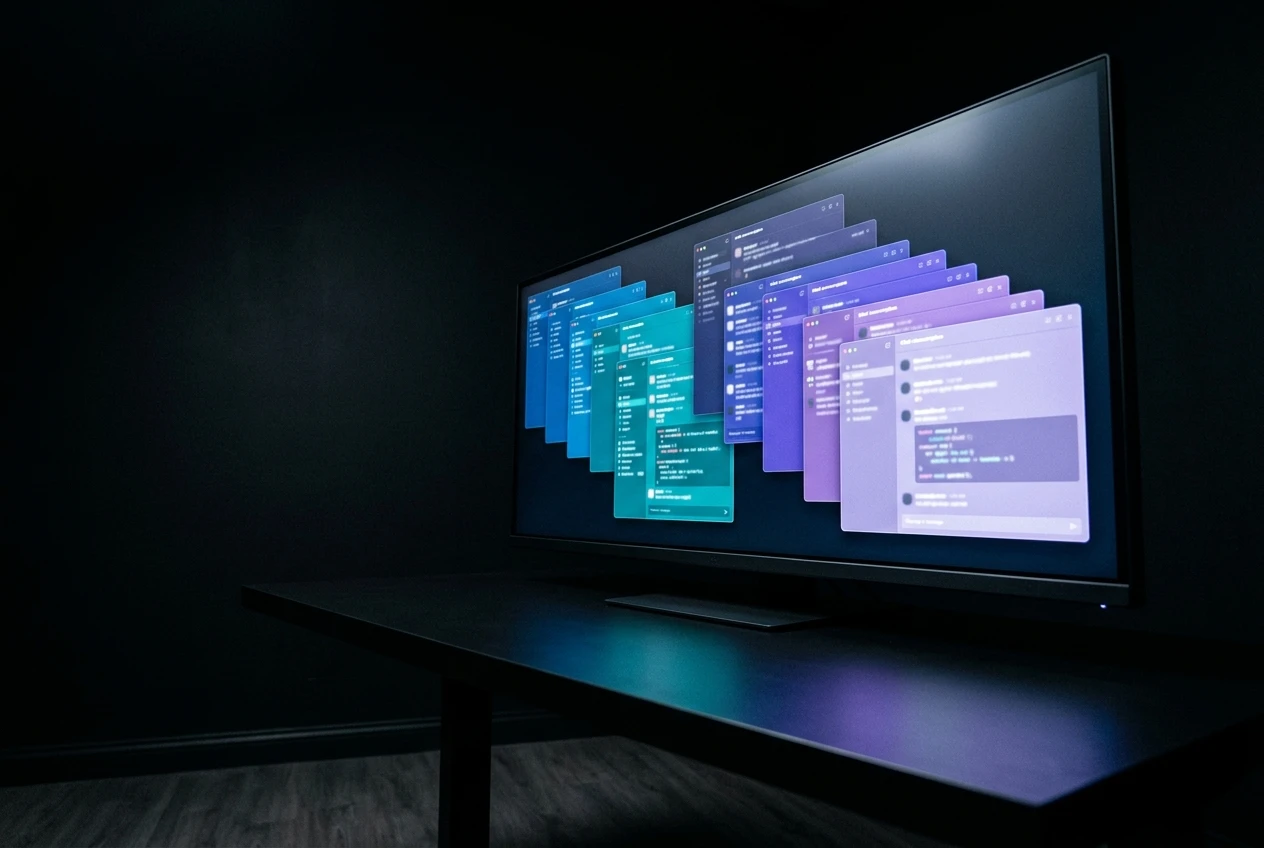
Cursor added two small features this week: Side Chats, for running a parallel AI conversation, and Transcript Search, for finding an old one instantly. Anysphere, the company behind the popular AI coding editor, built both to fix a problem long familiar to its power users, agent sessions that either fork into a mess or scroll past the point of no return.
The release landed less than a month after SpaceX said it was exercising its right to buy Cursor’s parent company for $60 billion, a deal expected to close in the third quarter of 2026.
Two Fixes for a Very Specific Kind of Chaos
Cursor’s own release notes describe the goal in one line: staying in flow with side chats that run alongside a main conversation, plus the ability to search agent transcripts and simplified project and repo pickers.
A side chat opens next to the primary agent window. A developer can ask a question, chase a tangent, or investigate a stray error without abandoning whatever thread is already running. Transcript Search does the opposite job. It pulls up an old exchange on command instead of forcing a scroll through weeks of history.
Neither problem is new. Developers frustrated by buried chat logs had already built their own fixes. One open source project on GitHub markets itself as the ultimate tool for browsing Cursor chat history, reading directly from the local database where Cursor stores conversations.
- Open a side chat to ask a question or chase an idea without losing the main thread
- Search past agent transcripts directly instead of scrolling through old sessions
- Use a redesigned branch picker that opens on the default branch and recent branches first, with search for the rest
- Manage personal machines, team pools and remote workspaces from one combined, searchable menu
Cursor’s changelog frames the update as built around staying in flow across long agent sessions.
Cursor’s Next Owner Is Already Decided
On June 16, SpaceX said it was exercising its right to buy Cursor’s parent company, Anysphere, in an all-stock deal that values the startup at $60 billion. The acquisition is expected to close in the third quarter of 2026, folding Anysphere under SpaceX’s xAI subsidiary.
The option came from xAI two months earlier. In April, Elon Musk’s rocket and AI company offered Cursor’s owners a choice: sell outright for $60 billion, or take $10 billion for a joint work arrangement instead. The offer arrived while Cursor was reportedly negotiating a separate $50 billion Series E with Thrive Capital and Andreessen Horowitz. That round never closed.
Months earlier, Cursor had been the one doing the acquiring. In December, it agreed to buy Graphite, a New York-based code review startup, in a deal reported to price well above Graphite’s most recent $290 million valuation.
Anysphere itself is young. Four MIT students, Michael Truell, Sualeh Asif, Arvid Lunnemark and Aman Sanger, incorporated the company in 2022. None had founded a company before.
| Date | Milestone | Valuation or Deal Size |
|---|---|---|
| August 2024 | Series A valuation, led by Andreessen Horowitz | $400 million |
| June 2025 | Series C, led by Thrive Capital | $9.9 billion |
| November 2025 | Series D, co-led by Accel and Coatue | $29.3 billion |
| April 2026 | xAI grants SpaceX a purchase option | $60 billion |
| June 16, 2026 | SpaceX exercises the option | $60 billion, closing expected Q3 2026 |
The jump from $400 million to $60 billion took less than two years.
A Crowded Field Converges on the Same Fix
Cursor covered some of this same ground itself in April, with a dedicated view for running several chats side by side. Side Chats extends that idea to shorter, throwaway conversations that do not need their own tab.
Anthropic’s Claude Code already ships subagents for parallel development workflows, along with checkpoints that automatically save state before changes. OpenAI’s Codex takes a different shape but solves the same problem. Assign issues, and Codex works through them in parallel containers, reviewed as a batch once finished. Google entered the same race on November 18, 2025, shipping Antigravity in public preview the same day Gemini 3 arrived.
Claude Code has pulled ahead on developer enthusiasm specifically. A survey of 906 software engineers by the Pragmatic Engineer in February 2026 found it the most-used AI coding tool, with a 46% “most loved” rating, and separate estimates credited it with roughly 4% of all public GitHub commits by March, with projections near 20% by year end. Codex, meanwhile, passed 3 million weekly active users in the same stretch, up from 2 million a month earlier.
The Math Behind a $60 Billion Bet
Cursor’s revenue backs up some of the enthusiasm. Annualized revenue crossed $1 billion in November 2025 and topped $2 billion by February 2026. It passed $3 billion in the months after, and reports in May put the figure past $4 billion.
The company says its tools are used to write 150 million lines of enterprise code every day, and Fortune put its Fortune 500 penetration at 67% as of March.
Analysts do not agree on whether $60 billion is a fair price.
- Bull case: Martin Casado, an Andreessen Horowitz general partner and Cursor board member, says “if you subtract out the dollars invested, it’s the fastest-growing company we’ve ever seen.”
- Bear case: Reporting cited in market analysis says Cursor ran negative gross margins until recently, with individual developer accounts reportedly still unprofitable even as enterprise accounts turn positive.
- Structural risk: Cursor has depended on Anthropic and OpenAI from the start, building its product on their models even as both labs race to ship competing coding tools of their own.
Cursor would need annualized revenue above $6 billion for the $60 billion price to look like an ordinary hypergrowth multiple, New Market Pitch’s analysis of the deal argues, rather than a strategic premium.
What Do Developers Still Complain About?
Developers flag three recurring problems: bills that land well above the advertised price, security disclosures tied to real vulnerabilities, and a support system that has invented policy before. None of the three are new, and Cursor has already apologized for two of them this year.
Real bills commonly land at $40 to $50 a month, well past the advertised $20 base, once per-request overage fees above the monthly allocation kick in.
On security, researchers have tied three proven remote code execution flaws, CVE-2025-59944, CVE-2025-54135 and CVE-2025-54136, to the editor, alongside a Workspace Trust setting that is disabled by default.
Trust problems go back further. In April 2025, an AI help desk agent named “Sam” invented a login policy that did not exist, prompting user cancellations before staff apologized and issued refunds. A July 2025 change to Cursor’s Pro plan pricing caused a similar scramble: unexpected charges, complaints, then an apology, rolled-back limits and refunds.
“it’s like building walls and a roof without checking the foundation and wiring”
Michael Truell, Cursor’s co-founder and chief executive, made the comparison at a Fortune Brainstorm AI conference, warning against handing an AI agent an entire task without reading what it produced. The concern echoes a pattern showing up elsewhere in AI tools that log daily work, where AI notetakers sliding from convenience into legal liability has already forced a rethink of default settings.
Anthropic Files for an IPO While Microsoft Chases
Cursor is not competing in a vacuum. Anthropic closed a financing round at a $965 billion valuation this month, surpassing OpenAI, and said it has confidentially filed for an IPO.
Microsoft and Google are both pushing harder into coding models to catch up. Microsoft geared up for coding announcements at its Build conference, following Google’s push at its own developer event in May. “It’s absolutely critical for these companies to compete in this market,” said Gil Luria, an analyst covering tech stocks at D.A. Davidson.
Microsoft’s own answer is already shipping: seven in-house MAI models aimed at cutting AI costs. OpenAI already answered the coding land grab once this year too, buying rival Windsurf for roughly $3 billion.
The $60 billion deal is still on track to close this quarter, putting Cursor’s next roadmap in someone else’s hands.
Frequently Asked Questions
Is Side Chats Available on Cursor’s Free Plan?
Cursor’s pricing did not change with this release. As of July 2026, the Hobby plan remains free with limited usage, Pro costs $20 a month, Pro+ is $60, Ultra is $200, and Teams runs $40 per user a month.
Which AI Models Can Cursor’s Agents Use?
Cursor is model-agnostic rather than tied to one lab. Per the company’s own documentation, developers can choose between OpenAI’s GPT-5.5, Anthropic’s Opus 4.8 and Claude models, Google’s Gemini 3.1 Pro, xAI’s Grok, and Cursor’s own Composer model, switching between them inside the same project.
Can My Whole Team See These New Conversations?
Not automatically. Cursor’s existing Shared Transcripts tool, a separate capability limited to Team and Enterprise plans, keeps team links open only to signed-in members while public links need no sign-in at all.
Does Cursor Train on My Code by Default?
Yes, unless a developer manually turns on Privacy Mode. With Privacy Mode off, which is the default setting, Cursor’s own data use policy allows the company to store code, prompts and editor actions to improve its AI features and train models.
How Big Is the Team Behind a $60 Billion Product?
Roughly 300 people, as of the company’s most recent public disclosures. Cursor told investors in its November 2025 Series D announcement that its team had grown past 300 engineers, researchers, designers and operators.
Is Cursor’s Advertised 200,000-Token Context Window Real?
Only partly, according to independent testing. Cursor advertises a 200,000-token context window, but outside testing puts effective usable context closer to 70,000 to 120,000 tokens once internal truncation is factored in.


South Korea Retail Investors Face Reckoning After KOSPI AI Rally Collapses

Surrey AI Maps Three Heart Attack Paths and Their Molecular Roots

Germany Locks Neutral Apple ATT Prompts Across Most of Europe

Apple’s 5% EU Fee Quietly Rewrites Alternative App Store Math

Apple’s EU Fee Truce Cuts Complexity but Leaves Rivals Fuming

Pixel 11 Pro Fold Trades Thinness for Durability and Seven-Year Stay

Mayo AI Flags HCM Obstruction From Everyday Ultrasound Videos

Indian Brands Quietly Scale Landmark Screens and Home Tech

Navin Vatsa Turns Grief Into a Lifetime of Quiet Seeing

Google Bets Pixel 11 Agentic AI Will Redefine Phones

Oracle Cuts 21,000 Jobs in a Year, Cites AI in 10-K Filing

Fable 5 and Mythos 5 Return as US Lifts Anthropic Export Controls

SpaceX’s Google Deal Turns a Rocket Company Into a Cloud Landlord

CD Projekt Red Co-CEO: Redemption Arc Isn’t Done, Witcher 4 in 2027

XPL Rallies 30% Ahead of Plasma One Card Tier Launch

Google Search Profiles Build a Follow Graph Inside Discover

DGO App Brings Rs 549 Mobile Pass for FIFA World Cup 2026 in Nepal

Moonshot AI Targets $30 Billion in China’s Fastest AI Funding Sprint

Oppo’s ColorOS 17 Eligibility List Leaves A-Series Buyers Behind

Microsoft Xbox Layoffs Start in July as Sharma Slams 3% Margin
-
 AI2 months ago
Oracle Cuts 21,000 Jobs in a Year, Cites AI in 10-K Filing
-
 AI2 months ago
Fable 5 and Mythos 5 Return as US Lifts Anthropic Export Controls
-
 AI3 months ago
SpaceX’s Google Deal Turns a Rocket Company Into a Cloud Landlord
-
 GAMING2 months ago
CD Projekt Red Co-CEO: Redemption Arc Isn’t Done, Witcher 4 in 2027
-
 CRYPTO2 months ago
XPL Rallies 30% Ahead of Plasma One Card Tier Launch
-
 NEWS3 months ago
Google Search Profiles Build a Follow Graph Inside Discover
-
 APPS2 months ago
DGO App Brings Rs 549 Mobile Pass for FIFA World Cup 2026 in Nepal
-
 AI3 months ago
Moonshot AI Targets $30 Billion in China’s Fastest AI Funding Sprint